Outside Broadcast Services: How TV Trucks Power Live Productions Anywhere

In the era of on-demand video and live streaming, delivering high-quality content from anywhere in the world is no longer a luxury-it’s a necessity. Whether it’s a professional sports event, a political debate, a red-carpet premiere, or a major corporate conference, audiences expect smooth, real-time video coverage with exceptional quality.

This is where outside broadcast services come into play. At the core of these services are TV trucks, also known as outside broadcast trucks, television trucks, or mobile broadcast units. These vehicles house the technology, teams, and broadcasting systems required to produce and transmit live content from virtually any location.

At Live Media Group, we specialize in providing state-of-the-art outside broadcast services through one of the most versatile and technologically advanced fleets of production vehicles in North America. Whether you’re producing for broadcast television or digital platforms, our TV trucks and integrated broadcasting systems deliver reliable, scalable solutions.

What Are Outside Broadcast Services?

Outside broadcast services refer to the complete setup required to produce and transmit live television or streaming content from a location outside a traditional studio. These services typically include:

  • Multi-camera live video production
  • Audio mixing and synchronization
  • Replay and slow-motion systems
  • Intercom and communications infrastructure
  • Graphics and real-time overlays
  • Signal routing and distribution
  • Uplink and transmission to broadcasters or streaming platforms

The central hub of these services is the outside broadcast truck, a specialized television truck equipped with all the broadcasting systems necessary to manage a live production on-site.

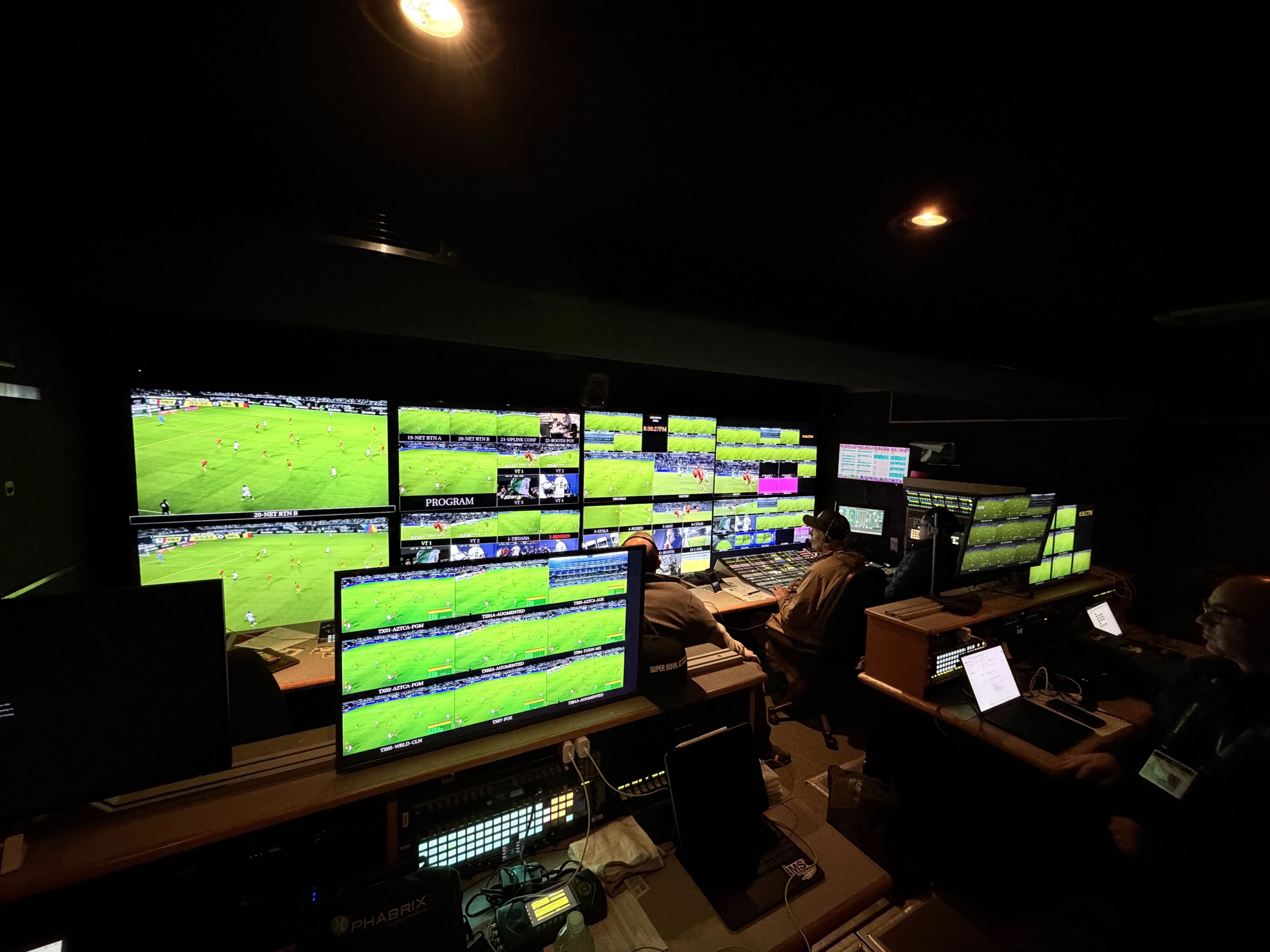
Inside a Modern Outside Broadcast Truck

The days of minimal control gear in a small van are long gone. Today’s outside broadcast trucks are full-scale production facilities on wheels. Depending on the event scale, they range from compact flypack support units to full double-expando TV trucks equipped with dozens of workstations and UHD capabilities.

  • Typical systems inside a television truck include:
  • Production switchers (e.g., Grass Valley K-Frame, Kayenne)
  • Replay servers (e.g., EVS XT-VIA, XT3, or XFile3)
  • Multiviewer displays for directors and producers
  • Audio consoles (e.g., Calrec Artemis, Argo, or Apollo)
  • Comms platforms (e.g., RTS ADAM, ODIN, or Clear-Com Eclipse)
  • Video and audio routers (Evertz, Ross Ultrix, GV Node)
  • Uplink integration for satellite, fiber, or IP streaming
  • Power redundancy and HVAC for field reliability

These broadcasting systems ensure that every signal-video, audio, comms, or tally-is perfectly timed, routed, monitored, and delivered, whether it’s going to a national network or a global livestream.

Key Applications for TV Trucks and OB Services

Live productions are high-pressure environments that leave no room for error. That’s why the precision and mobility of outside broadcast trucks are in demand across a wide range of industries and events:

  1. Sports Broadcasting: From football stadiums and basketball arenas to motorsports tracks and Olympic venues, sports demand multi-camera coverage, live replay, and instant highlights. TV trucks serve as the central hub for camera feeds, announcer audio, and transmission uplinks.
  1. Entertainment and Festivals: Music festivals, award shows, and concert tours often occur in outdoor venues or pop-up locations. A television truck can act as the main production control room, integrating audio, video, and graphics on-site for both live screens and global streaming.
  1. Corporate Events: Large corporate events and keynotes need polished live video for internal broadcasts or customer-facing streams. Outside broadcast services deliver reliable multi-camera coverage with professional-grade mixing and branded overlays.
  1. Political and Government Coverage: Press conferences, debates, and elections require secure, high-quality production with fail-safe broadcast paths. OB trucks allow news teams to provide live feeds to multiple networks simultaneously.
  1. Remote Integration (REMI): In REMI workflows, cameras and audio feeds are captured on-site and sent to a centralized control room. Live Media Group’s mobile REMI units integrate perfectly with OB trucks to support scalable hybrid workflows.

Why Choose Live Media Group for Outside Broadcast Services?

At Live Media Group, we’ve invested in building a diverse fleet of mobile broadcast trucks, REMI-capable units, and support trailers to meet the growing complexity of live production. Our outside broadcast services offer:

  • UHD and HDR compatibility
  • IP and baseband hybrid infrastructures (ST2110, 12G, 3G)
  • Full redundancy in power, routing, and comms
  • Multi-platform distribution (TV, social, web)
  • Expert crews and nationwide deployment

Every mobile TV truck in our fleet is optimized for real-world conditions and prepped for fast setup, making it easy for crews to focus on delivering the highest-quality content without worrying about infrastructure.

What Sets a Broadcast Truck Apart from a Studio?

While studios offer fixed infrastructure, outside broadcast trucks provide studio-quality production capabilities wherever the event is happening. The benefits of using a mobile television truck include:

  • Mobility: The truck goes where the event is.
  • Speed: Setup is faster compared to temporary control rooms.
  • Cost-efficiency: No need to build out separate spaces or rent equipment piecemeal.
  • Consistency: Same team, same systems, every time.
  • Integrated transmission: Many units include satellite uplinks or IP delivery options.

When paired with support trailers (like Live Media Group’s MU-B1 or MU-B9), crews also get climate-controlled workspaces, cable prep zones, and overflow seating to support larger shows.

Frequently Asked Questions (FAQ)

What is an outside broadcast truck?

An outside broadcast truck (OB truck) is a mobile unit equipped with professional-grade video and audio production tools used to produce live events from remote locations. It acts as a mobile studio and control room.

How many cameras can a TV truck support?

Most TV trucks can support between 6 and 20+ cameras depending on the router size, switching capability, and available CCUs. Some units are expandable for even more complex coverage.

Can OB trucks be used for streaming?

Yes. Most modern outside broadcast services include integrated live streaming support alongside traditional broadcast transmission. Trucks are equipped with encoders and connectivity to stream to social platforms or OTT channels.

What is the difference between a production truck and a broadcast truck?

A production truck focuses on capturing and mixing video and audio signals, while a broadcast truck typically includes both production and transmission gear (e.g., satellite uplink or IP transport). Many modern vehicles combine both functions.

How are OB trucks powered?

Typically, OB trucks run on shore power or on-site generators. Power requirements usually include three-phase or single-phase 208V service, often with camlock inputs.

Book an OB Unit with Live Media Group

Whether you’re producing television, digital platforms, or internal enterprise networks, Live Media Group’s outside broadcast services offer the flexibility, technology, and support you need to execute flawlessly.

With TV trucks, television trucks, video production trucks, and full-service support vehicles available coast to coast, we are your partner in premium live content delivery.

Contact us at solutions@livemediagroup.com or call 833.933.5483 to speak with our team about configuring your next OB deployment.

The Role of Mobile TV Trucks in Modern Video Production

In today’s fast-paced media landscape, the demand for high-quality live video content is greater than ever. From live sports broadcasts and music festivals to corporate events and breaking news coverage, producers require flexible, powerful, and reliable solutions to bring content to audiences in real time. This is where mobile TV trucks, also known as mobile broadcast trucks, OB (Outside Broadcast) units, and mobile video production trucks, play a crucial role.

At Live Media Group, we specialize in providing state-of-the-art mobile TV production trucks designed to deliver broadcast-quality video and audio from virtually any location. In this article, we’ll explore how these vehicles operate, the technology they house, and why they’re indispensable to modern video production workflows.

What Is a Mobile TV Truck?

A mobile TV truck is a specialized vehicle that serves as a mobile control room for live video and audio production. These trucks are fully outfitted with the equipment and personnel needed to produce, switch, mix, and transmit content from remote locations. Often referred to as OB trucks (short for Outside Broadcast), these units are the backbone of live event broadcasting and streaming.

At their core, mobile video production trucks offer the same capabilities as a traditional television studio-except everything is housed in a trailer or expando vehicle that can be driven directly to a venue. Whether it’s a concert in a stadium, a red-carpet premiere, or a government press conference, mobile production trucks are engineered to be deployed wherever the story unfolds.

Mobile Video Production Trucks: What’s Inside?

A high-end video production truck includes an array of cutting-edge technology that supports end-to-end content creation. At Live Media Group, our fleet includes everything from compact single-expando units to full double-expando production and transmission powerhouses.

  • Inside a typical mobile broadcast truck, you’ll find:
  • Production switchers such as Grass Valley Kayenne or K-Frame series
  • Multiview monitoring walls for directors, producers, and TDs
  • Audio consoles like Calrec Artemis, Apollo, or Argo for surround sound mixing
  • Replay systems such as EVS XT-Via or XT3 servers
  • Camera control units (CCUs) and tally systems
  • Routing infrastructure, including Evertz and Ross video/audio routers
  • Comms systems, including RTS ADAM or ODIN matrix intercoms
  • Power and environmental systems for field reliability
  • IP and baseband hybrid capabilities, including ST2110 and SMPTE routing

These trucks are staffed by directors, engineers, audio technicians, replay operators, shader techs, and production managers who collaborate in real time to produce a seamless broadcast or stream.

Why Use a Mobile Broadcast Truck?

The use of a mobile broadcast truck brings unmatched flexibility to productions that cannot be confined to a studio. Here’s why these units are so valuable:

  1. Remote Capability: OB trucks enable full-scale production in remote or temporary locations where permanent infrastructure does not exist. Whether it’s a beach, racetrack, mountain summit, or urban plaza, these trucks bring the studio to the scene.
  1. Time Efficiency: Live productions often operate on tight schedules. Mobile production trucks can be deployed quickly, set up efficiently, and strike rapidly post-show-saving crews valuable time and reducing logistical complexity.
  1. Scalability: From small single-camera events to massive multi-camera broadcasts with 20+ sources, mobile video production trucks can be scaled to meet the needs of the production. Trucks can also be paired with support units and flypacks to further extend functionality.
  1. Cost-Effective: Compared to building out a temporary control room from scratch, mobile TV trucks offer a cost-effective, all-in-one solution that reduces equipment rental, setup, and coordination overhead.
  1. Broadcast and Streaming Integration: Modern mobile TV trucks are equipped not only for broadcast transmission but also for simultaneous streaming, recording, and post-production handoff. This hybrid capability is crucial for today’s multi-platform distribution strategies.

Mobile TV Trucks and Live Media Group

At Live Media Group, we operate one of the most technically advanced and versatile fleets of mobile broadcast trucks in the United States. Our lineup includes:

  • UHD, HDR-ready mobile control units
  • Dedicated REMI (Remote Integration Model) trucks for decentralized workflows
  • OB trucks with integrated C-band and Ku-band uplink systems
  • Single and double expando vehicles
  • Audio-dedicated trucks with world-class consoles and multi-track recording
  • Support trailers with flypack staging, crew workstations, and engineering bays
  • Each mobile TV truck is built to support live television, event streaming, corporate AV, and government production workflows, with flexibility for IP, SDI, or hybrid infrastructures.

Outside Broadcast: Evolving with Technology

The concept of Outside Broadcast (OB) has existed for decades, but the technology within OB trucks continues to evolve. Today’s OB units support IP-based production, real-time remote contribution, and even virtualized control rooms. As production demands grow more complex, mobile production trucks have evolved into command centers capable of everything from local switching to cloud-based integration.

At Live Media Group, our OB solutions are future-ready-supporting 3G, 12G, ST2110, MADI, DANTE, and SMPTE 2110 signal types, along with advanced routing, monitoring, and comms systems for hybrid cloud-ground environments.

Choosing the Right Mobile Video Production Truck

When planning a production, choosing the right video production truck is critical. Consider the following factors:

  • Event scale (number of cameras, replay, graphics)
  • Transmission needs (broadcast, streaming, satellite uplink)
  • Audio requirements (surround mixing, multi-track, comms complexity)
  • Venue logistics (space constraints, power availability)
  • Crew size and workstation configuration

Live Media Group offers production planning and truck configuration consultation to help clients select the right unit-or combination of units-for each show.

Frequently Asked Questions (FAQ)

What is a mobile TV truck used for?

A mobile TV truck is used to produce, switch, mix, and broadcast or stream live video content from a remote location. It acts as a mobile studio control room.

What’s the difference between a mobile video production truck and an OB truck?

They are often the same thing. OB (Outside Broadcast) truck is the traditional term used in the broadcast industry, while “mobile video production truck” is more common in digital and hybrid workflows.

How many cameras can a mobile TV truck support?

It depends on the truck. Some support 4-6 cameras, while larger OB units can support 12-20+ cameras including specialty formats like super-slo-mo, RF, and POV.

Can mobile broadcast trucks handle live streaming?

Yes. Most modern mobile broadcast trucks are fully capable of integrating live streaming platforms alongside traditional broadcast transmission paths.

What types of events use OB trucks?

Live sports, music festivals, political events, conferences, red carpet shows, esports tournaments, and breaking news coverage all rely on OB trucks for reliable, high-quality live production.

How much does it cost to rent a mobile video production truck?

Costs vary based on truck size, duration, crew needs, and location. Live Media Group offers scalable solutions from compact REMI trucks to large UHD OB units-contact our team for pricing.

Bring the Studio to the Field with Live Media Group

Whether you need a mobile TV truck, an OB production unit, or a mobile broadcast truck integrated with satellite uplink and REMI capabilities, Live Media Group has the expertise and the fleet to deliver. Our team supports everything from high-profile live sports broadcasts to corporate communications and branded digital experiences-with a commitment to flexibility, reliability, and innovation.


To learn more about our mobile units, contact our production team directly at solutions@livemediagroup.com or call 833.933.5483.