The deal includes three premium mobile units, engineering personnel, existing broadcast contracts, and a strategic partnership encompassing RF, specialty cameras, and other production services
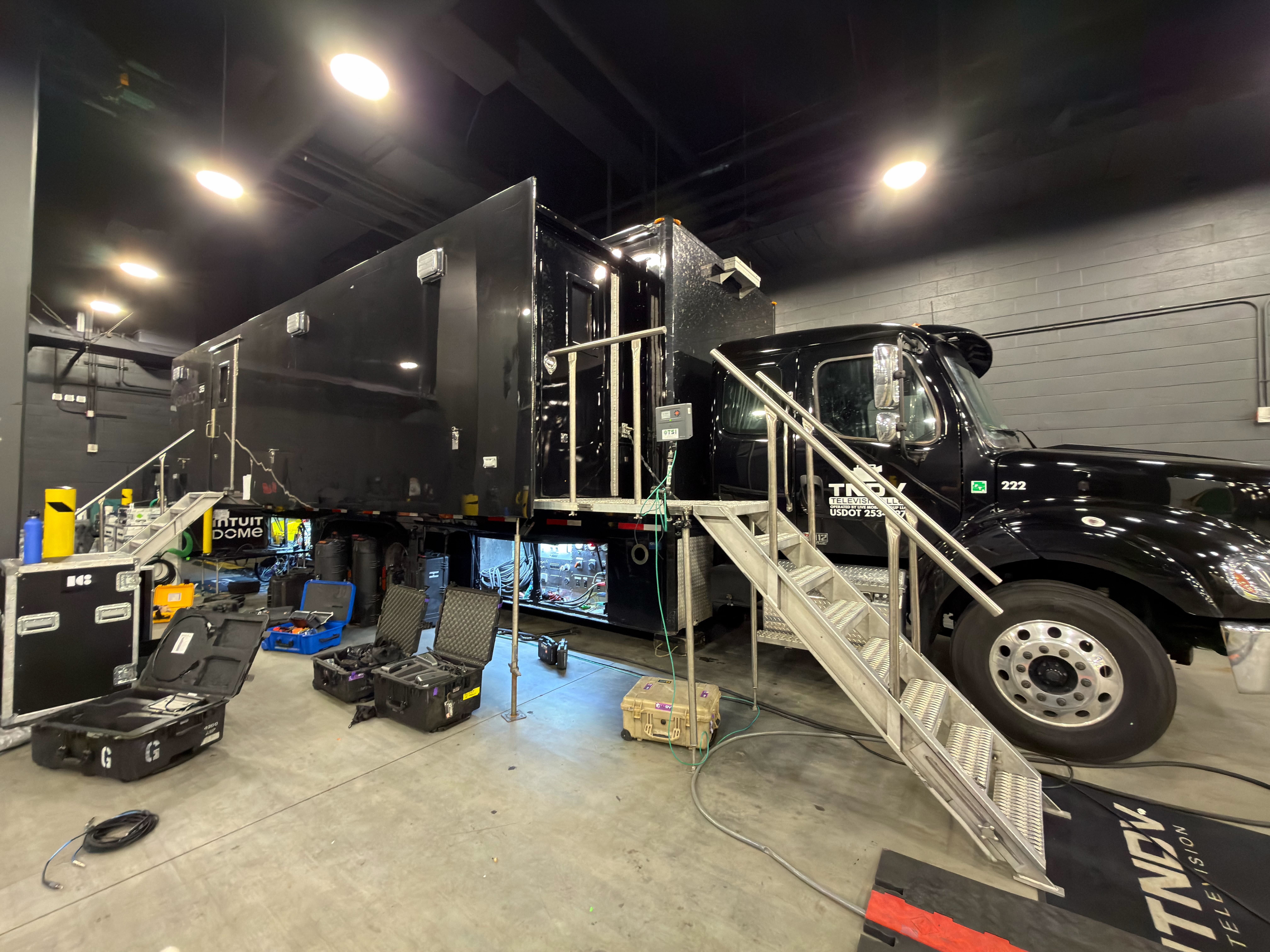
Big news in the domestic production-truck business this week: Live Media Group has acquired Gravity Media’s U.S. mobile-production assets, adding eight units, experienced engineering personnel, and several long-term client contracts to its growing nationwide operation.
The transaction involves three premium production trucks currently assigned to major U.S. broadcast partners and professional events. It also establishes a long-term strategic partnership through which Live Media Group and Gravity Media can combine mobile facilities, RF technology, specialty cameras, flypacks, and other production services for domestic and international clients. Financial terms of the acquisition were not disclosed.
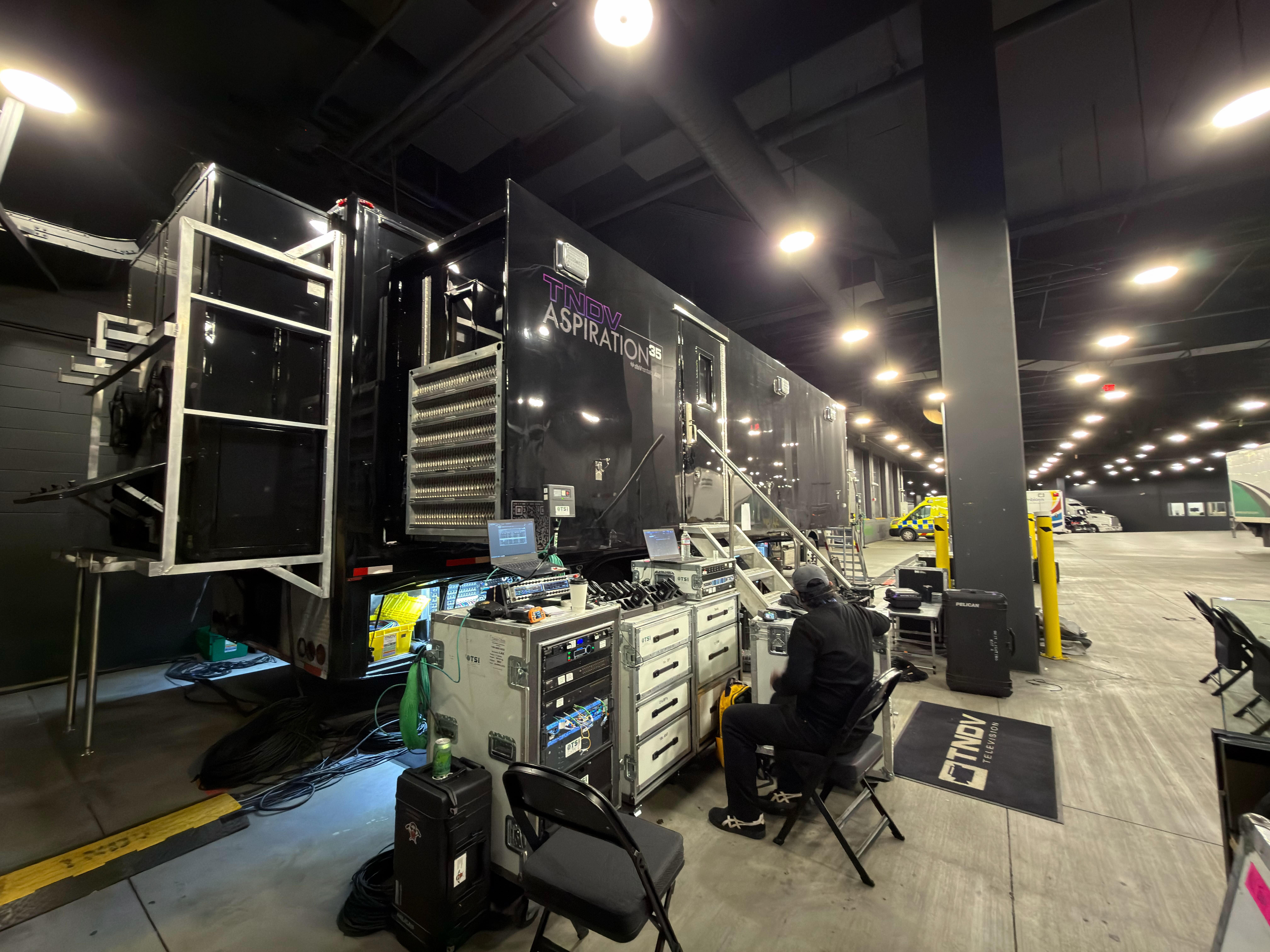
The eight units will join a Live Media Group fleet of more than 35 production trucks. The additional resources will be available across the company’s operating businesses: TNDV Television, Live Media, and GameTime Productions.
“Every acquisition we’ve made has been driven by one objective: creating more opportunities to better serve our clients,” says Live Media Group founder/President/CEO Brad Sexton. “We’ve never pursued growth simply to become bigger. We’ve focused on bringing together exceptional companies, talented people, and complementary capabilities that allow us to deliver more strategic value across the country. This acquisition continues that strategy by expanding our fleet, adding experienced engineering talent, and giving us additional resources to meet growing client demand.”
REMI-Capable Units Fit the Production Model
The acquisition comes as Live Media Group sees increased demand for distributed and at-home production models. According to company executives, several of the newly acquired units are particularly well-suited to the REMI workflows that are a growing part of the company’s business.
Three mobile units — Columbus, Whiskey, and Aspen — stand out as especially strong fits for Live Media Group’s existing operation.
“The fleet complements our fleet and slides into our business model,” says Ryan Hatch, SVP, Live Media Group. “It’s something we’re focused on more: the REMI model, which is what those trucks are built for. Ultimately, I think it increases our focus on that business, and it fits our mold. It’s our niche of hitting that model, which is quite honestly our strength.”
The units also support Full HD and HDR productions, providing Live Media Group with additional assets capable of serving the technical requirements of major sports and entertainment clients.
Sexton cites the expanding use of REMI workflows on events ranging from the FIFA World Cup to golf and the Olympic Games as evidence that the trucks align with where the market is heading. “The majority of World Cup was done with the at-home, full-REMI production model. Then you take the PGA TOUR and the Olympic Games and how they are producing large-scale events. That’s the reason. It’s more assets that will do Full HD, HDR. It just reinforces what our clients are asking for.”
The acquisition offers a faster alternative to designing and constructing new mobile units. He notes that a new production truck can require 12-18 months to complete, whereas acquiring existing assets allows the company to add capacity immediately and integrate the units into its national scheduling operation.
Additional Capacity Addresses Growing Demand
The expansion arrives after a particularly busy period for Live Media Group. Its existing mobile units have routinely been booked throughout much of the year, requiring it to subrent trucks from other providers to fulfill commitments.
That trend, Sexton says, became especially noticeable during 2025, when Live Media Group relied on an unprecedented number of outside units to support contracted productions and longstanding client relationships. The Gravity Media assets provide the company with more control over that capacity while reducing the need to turn down projects or source trucks elsewhere.
“Historically, our mobile units have been fully committed most of the year,” says Michael Sullivan, president, Live Media. “These additional assets immediately provide us with greater scheduling flexibility while allowing us to support more clients without compromising the level of service they’ve come to expect. Rather than turning opportunities away, we’re now positioned to say yes to more productions.”
Along with the physical units, Live Media Group is adding members of Gravity Media’s U.S. engineering and technical team. The personnel bring experience operating the acquired trucks as well as additional skillsets that can be deployed across the broader organization.
The combination of additional trucks, equipment, and personnel is expected to strengthen Live Media Group’s work across sports, entertainment, corporate productions, and other live events. It also gives the company more flexibility during heavily booked portions of the sports calendar, particularly in the fall.
“It gives us more capacity and reach, which ultimately opens more doors for the people we work with,” says Hatch. “The goal has always been simple: be in a position to say yes to more with quality staff and assets. This is a meaningful step in that direction.”
Beyond the Trucks: A Strategic Partnership
Although Live Media Group will own and operate Gravity Media’s U.S. mobile-unit fleet, Gravity Media will remain involved in the market through the strategic partnership.
Gravity Media can continue supporting productions with its RF systems, specialty-camera resources, flypack capabilities, and other services. Live Media Group, meanwhile, will provide mobile-production facilities for Gravity Media’s international customers when they require support for events in the U.S.
The companies have worked together for several years, including instances when Live Media Group rented Gravity Media trucks to address scheduling constraints and when Gravity Media used Live Media Group’s production-packaging capabilities.
That relationship helped make the transaction a natural fit, according to Sexton. “We’ve worked with Gravity for years, both just subrenting their production trucks when our utilization is too high and we can’t cover, or they’ll rely on us on production packaging and different skillsets that we have but they may not have here in the U.S. It’s a natural partnership, and it’s long-term, which is fantastic.”
The continuing relationship gives both companies the ability to assemble broader packages without requiring either side to duplicate every technical capability internally. “This strengthens our ability to scale, expand capabilities, and better support clients across every major market we operate in,” says Jonae Taylor, SVP, sales, Live Media Group. “Alongside additions to our mobile fleet, this partnership also expands what we can offer across RF, specialty cameras, and flypacks for both international and domestic clients.”
The Gravity Media transaction is the latest in a series of acquisitions that have expanded Live Media Group’s footprint. The company acquired SureShot Teleproductions in 2015, TNDV Television and HARB Production Services in 2019, and Lyon Video in 2022.
https://www.livemediagroup.com/wp-content/uploads/2026/08/Whiskey_2-2.png15122016Chris Sturgeonhttps://www.livemediagroup.com/wp-content/uploads/2024/09/Live-Media-Group-Logo-Padded-300x41.pngChris Sturgeon2026-08-06 10:49:262026-08-06 10:52:04Live Media Group Acquires Gravity Media’s U.S. Mobile-Production Assets
GameTime Productions, Live Media, and TNDV work together to produce women’s professional basketball for Athletes Unlimited. Learn more here.
https://www.livemediagroup.com/wp-content/uploads/2026/03/GameTime-Athletes-Unlimited1-1068x801-1.jpg8011068Chris Sturgeonhttps://www.livemediagroup.com/wp-content/uploads/2024/09/Live-Media-Group-Logo-Padded-300x41.pngChris Sturgeon2026-06-08 14:17:032026-06-08 14:17:03Athletes Unlimited Expands Technical Vision with Live Media Group
TNDV and Live Media deliver the music for the NCAA Final Four both inside the arena and outside. Learn how our companies worked together to pull off this challenging event at SVG.
https://www.livemediagroup.com/wp-content/uploads/2026/05/TNDV-Final-Four-image2-1536x1152-1.jpg11521536Chris Sturgeonhttps://www.livemediagroup.com/wp-content/uploads/2024/09/Live-Media-Group-Logo-Padded-300x41.pngChris Sturgeon2026-06-08 13:52:322026-06-08 13:59:02TNDV and Live Media Support NCAA Final Four Weekend for 13th Consecutive Year
In the era of on-demand video and live streaming, delivering high-quality content from anywhere in the world is no longer a luxury-it’s a necessity. Whether it’s a professional sports event, a political debate, a red-carpet premiere, or a major corporate conference, audiences expect smooth, real-time video coverage with exceptional quality.
This is where outside broadcast services come into play. At the core of these services are TV trucks, also known as outside broadcast trucks, television trucks, or mobile broadcast units. These vehicles house the technology, teams, and broadcasting systems required to produce and transmit live content from virtually any location.
At Live Media Group, we specialize in providing state-of-the-art outside broadcast services through one of the most versatile and technologically advanced fleets of production vehicles in North America. Whether you’re producing for broadcast television or digital platforms, our TV trucks and integrated broadcasting systems deliver reliable, scalable solutions.
What Are Outside Broadcast Services?
Outside broadcast services refer to the complete setup required to produce and transmit live television or streaming content from a location outside a traditional studio. These services typically include:
Multi-camera live video production
Audio mixing and synchronization
Replay and slow-motion systems
Intercom and communications infrastructure
Graphics and real-time overlays
Signal routing and distribution
Uplink and transmission to broadcasters or streaming platforms
The central hub of these services is the outside broadcast truck, a specialized television truck equipped with all the broadcasting systems necessary to manage a live production on-site.
Inside a Modern Outside Broadcast Truck
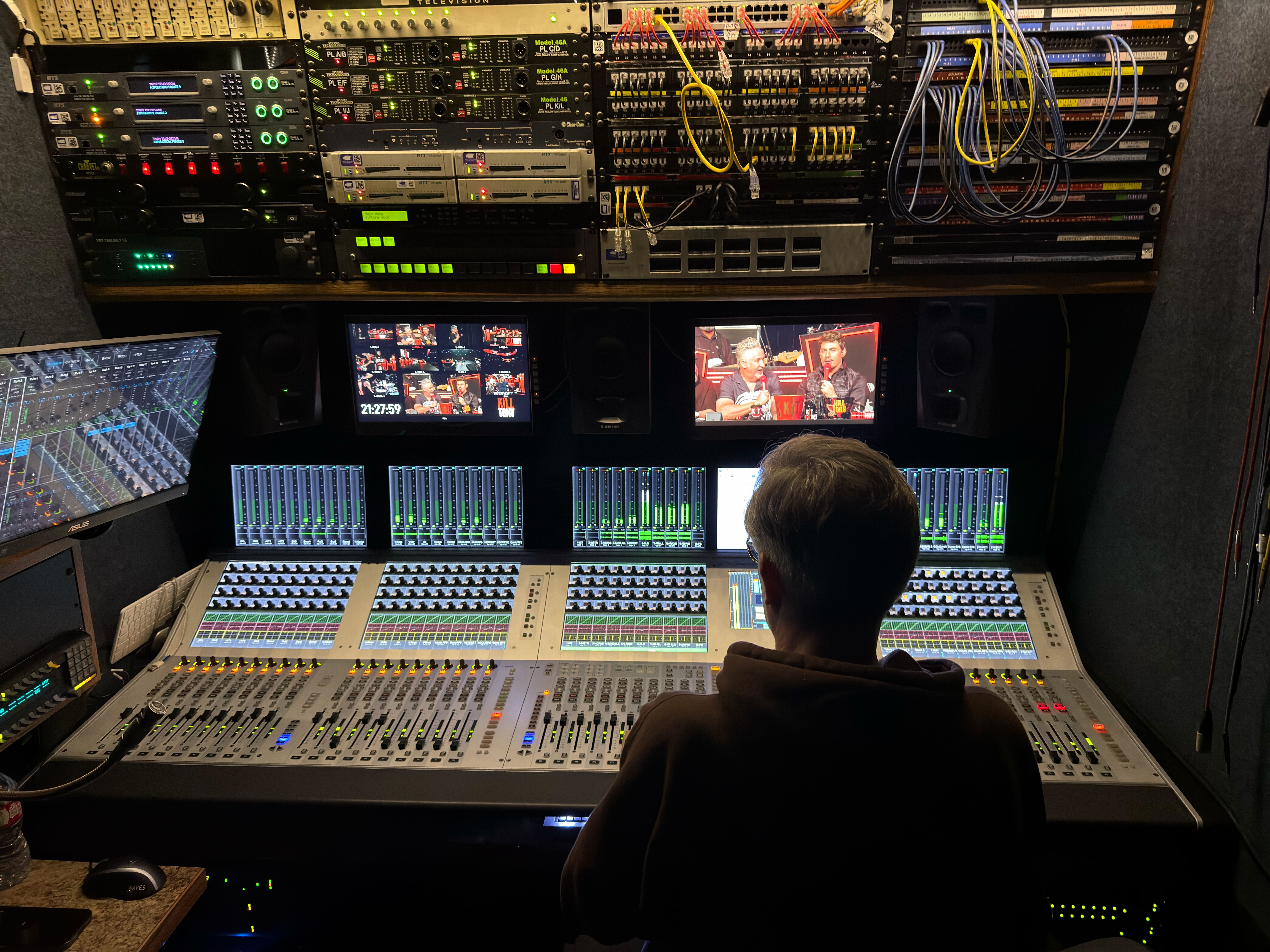
The days of minimal control gear in a small van are long gone. Today’s outside broadcast trucks are full-scale production facilities on wheels. Depending on the event scale, they range from compact flypack support units to full double-expando TV trucks equipped with dozens of workstations and UHD capabilities.
Typical systems inside a television truck include:
Production switchers (e.g., Grass Valley K-Frame, Kayenne)
Replay servers (e.g., EVS XT-VIA, XT3, or XFile3)
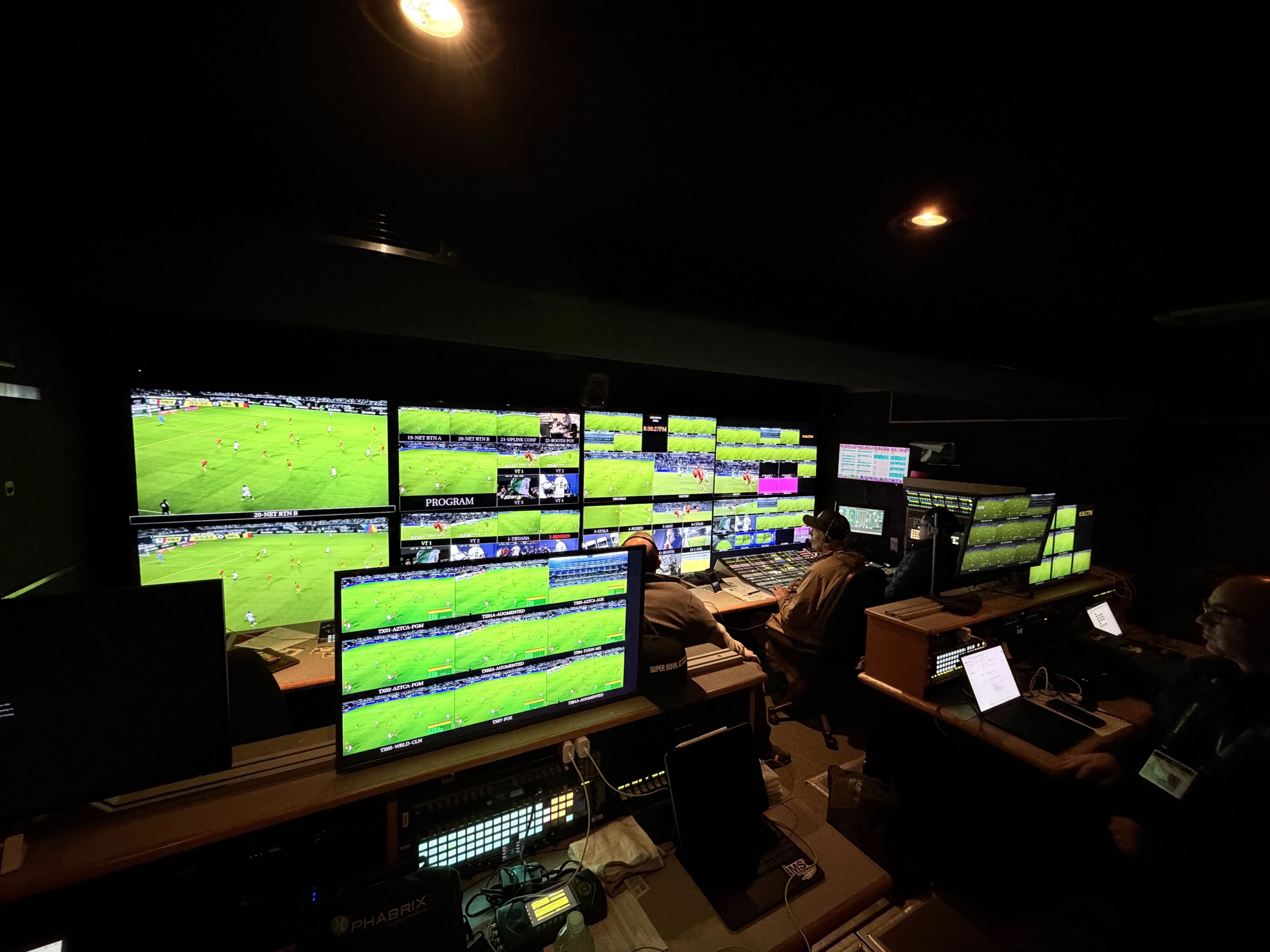
Multiviewer displays for directors and producers
Audio consoles (e.g., Calrec Artemis, Argo, or Apollo)
Comms platforms (e.g., RTS ADAM, ODIN, or Clear-Com Eclipse)
Video and audio routers (Evertz, Ross Ultrix, GV Node)
Uplink integration for satellite, fiber, or IP streaming
Power redundancy and HVAC for field reliability
These broadcasting systems ensure that every signal-video, audio, comms, or tally-is perfectly timed, routed, monitored, and delivered, whether it’s going to a national network or a global livestream.
Key Applications for TV Trucks and OB Services
Live productions are high-pressure environments that leave no room for error. That’s why the precision and mobility of outside broadcast trucks are in demand across a wide range of industries and events:
Sports Broadcasting: From football stadiums and basketball arenas to motorsports tracks and Olympic venues, sports demand multi-camera coverage, live replay, and instant highlights. TV trucks serve as the central hub for camera feeds, announcer audio, and transmission uplinks.
Entertainment and Festivals: Music festivals, award shows, and concert tours often occur in outdoor venues or pop-up locations. A television truck can act as the main production control room, integrating audio, video, and graphics on-site for both live screens and global streaming.
Corporate Events: Large corporate events and keynotes need polished live video for internal broadcasts or customer-facing streams. Outside broadcast services deliver reliable multi-camera coverage with professional-grade mixing and branded overlays.
Political and Government Coverage: Press conferences, debates, and elections require secure, high-quality production with fail-safe broadcast paths. OB trucks allow news teams to provide live feeds to multiple networks simultaneously.
Remote Integration (REMI): In REMI workflows, cameras and audio feeds are captured on-site and sent to a centralized control room. Live Media Group’s mobile REMI units integrate perfectly with OB trucks to support scalable hybrid workflows.
Why Choose Live Media Group for Outside Broadcast Services?
At Live Media Group, we’ve invested in building a diverse fleet of mobile broadcast trucks, REMI-capable units, and support trailers to meet the growing complexity of live production. Our outside broadcast services offer:
UHD and HDR compatibility
IP and baseband hybrid infrastructures (ST2110, 12G, 3G)
Full redundancy in power, routing, and comms
Multi-platform distribution (TV, social, web)
Expert crews and nationwide deployment
Every mobile TV truck in our fleet is optimized for real-world conditions and prepped for fast setup, making it easy for crews to focus on delivering the highest-quality content without worrying about infrastructure.
What Sets a Broadcast Truck Apart from a Studio?
While studios offer fixed infrastructure, outside broadcast trucks provide studio-quality production capabilities wherever the event is happening. The benefits of using a mobile television truck include:
Mobility: The truck goes where the event is.
Speed: Setup is faster compared to temporary control rooms.
Cost-efficiency: No need to build out separate spaces or rent equipment piecemeal.
Consistency: Same team, same systems, every time.
Integrated transmission: Many units include satellite uplinks or IP delivery options.
When paired with support trailers (like Live Media Group’s MU-B1 or MU-B9), crews also get climate-controlled workspaces, cable prep zones, and overflow seating to support larger shows.
Frequently Asked Questions (FAQ)
What is an outside broadcast truck?
An outside broadcast truck (OB truck) is a mobile unit equipped with professional-grade video and audio production tools used to produce live events from remote locations. It acts as a mobile studio and control room.
How many cameras can a TV truck support?
Most TV trucks can support between 6 and 20+ cameras depending on the router size, switching capability, and available CCUs. Some units are expandable for even more complex coverage.
Can OB trucks be used for streaming?
Yes. Most modern outside broadcast services include integrated live streaming support alongside traditional broadcast transmission. Trucks are equipped with encoders and connectivity to stream to social platforms or OTT channels.
What is the difference between a production truck and a broadcast truck?
A production truck focuses on capturing and mixing video and audio signals, while a broadcast truck typically includes both production and transmission gear (e.g., satellite uplink or IP transport). Many modern vehicles combine both functions.
How are OB trucks powered?
Typically, OB trucks run on shore power or on-site generators. Power requirements usually include three-phase or single-phase 208V service, often with camlock inputs.
Book an OB Unit with Live Media Group
Whether you’re producing television, digital platforms, or internal enterprise networks, Live Media Group’s outside broadcast services offer the flexibility, technology, and support you need to execute flawlessly.
With TV trucks, television trucks, video production trucks, and full-service support vehicles available coast to coast, we are your partner in premium live content delivery.
Contact us at solutions@livemediagroup.com or call 833.933.5483 to speak with our team about configuring your next OB deployment.
https://www.livemediagroup.com/wp-content/uploads/2026/03/IMG_7832-1-scaled.jpg19202560Chris Sturgeonhttps://www.livemediagroup.com/wp-content/uploads/2024/09/Live-Media-Group-Logo-Padded-300x41.pngChris Sturgeon2026-06-01 12:49:592026-06-08 14:21:45Outside Broadcast Services: How TV Trucks Power Live Productions Anywhere
Audiences today expect more from live streaming than a single static camera pointed at a stage. Whether they are watching a sporting event, a concert, a corporate keynote, a worship service, or an awards show, viewers expect dynamic camera angles, smooth transitions, clean audio, real-time graphics, and reliable delivery across every screen and platform. That level of quality does not happen by accident. It requires a professional multi-camera live streaming setup built for the demands of real-time production.
Multi-camera live streaming is the process of capturing a live event from multiple camera positions and switching between those feeds in real time to create a polished, broadcast-quality program that is delivered to streaming platforms, broadcast networks, or both. It is the same fundamental approach used in television production, applied to the growing world of digital and hybrid distribution.
For organizations that need their live events to look and sound professional, the difference between a consumer-grade single-camera stream and a properly engineered multi-camera production is enormous. It is the difference between watching a flat, unedited feed and watching a finished show with storytelling, pacing, replay, graphics, and reliable transmission.
Live Media Group has built its business around exactly this kind of production. With more than 30 mobile production units, customizable fly pack systems, dedicated control rooms in Nashville, REMI production capabilities, and experienced crews, the company provides turnkey multi-camera live streaming for events of every scale. Its three divisions, Live Media, TNDV Television, and GameTime Productions, serve sports, entertainment, corporate, religious, and community events across the country and globally.
What Makes a Professional Multi-Camera Live Streaming Setup Different
There is a wide spectrum of multi-camera streaming solutions available today. On one end, consumer tools and app-based platforms allow individuals to connect smartphones or webcams and switch between angles using software on a laptop. These tools have a place for simple, low-stakes use cases.
On the other end of the spectrum is broadcast-grade multi-camera live streaming, the kind used for professional sports, nationally distributed concerts, high-profile corporate events, and large-scale worship productions. At this level, the setup involves professional cameras with dedicated operators, hardware video switching, engineered audio mixing, real-time graphics, instant replay, signal routing, communications infrastructure, redundant transmission paths, and experienced production teams coordinating every element in real time.
The distinction matters because professional multi-camera streaming is not just about having more than one camera. It is about having the entire production ecosystem required to turn those camera feeds into a finished program that meets broadcast standards. That includes switching at the right moment to tell the story, mixing audio so commentary, music, and crowd sound are balanced, inserting graphics and scores on cue, providing replays that enhance the viewing experience, and delivering the final output reliably to every distribution endpoint.
Live Media Group’s mobile unit fleet and fly pack systems are engineered for this level of production. The company’s publicly listed capabilities include multi-camera production support across its entire fleet, Ross Video Ultrix Acuity switching platforms, Ross XPression real-time graphics, EVS replay systems, multitrack audio with MADI technology and up to 96-channel Pro Tools integration, and HD and 4K streaming with secure high-speed connectivity. These are not consumer tools. They are broadcast systems deployed inside purpose-built mobile production environments.
The Core Components of a Multi-Camera Live Streaming Setup
A professional multi-camera live streaming production involves multiple interconnected systems working together in real time. Understanding the key components helps event producers and organizations make informed decisions when planning a live production.
Cameras and Acquisition
The foundation of any multi-camera production is the cameras themselves. Professional live events typically use broadcast-grade cameras operated by trained camera operators who frame shots, follow action, and respond to the director’s instructions. Depending on the event, a production might use anywhere from three cameras for a simple corporate stream to more than a dozen for a major sports broadcast.
Camera selection depends on the event type, venue conditions, and production goals. Large sports and entertainment productions often use studio-style broadcast cameras with large lenses for long-range coverage. Smaller events or tight venues may use compact cameras, robotic PTZ cameras, or cinema-style cameras. Live Media Group’s TNDV division offers a wide range of camera options for its fly pack productions, including broadcast cameras, Sony cinema-grade cameras like the FX9, F55, and Venice, as well as robotic PTZ cameras for specialized applications.
Video Switching and Routing
Once camera feeds are captured, they need to be managed and switched in real time. The video switcher is the nerve center of any multi-camera production. It allows the director or technical director to select which camera feed is live at any given moment, execute transitions between shots, and layer in graphics, replay, and other visual elements.
Professional switching systems like the Ross Video Ultrix Acuity platform, which Live Media Group integrates into its control rooms and mobile units, provide the speed, reliability, and flexibility that live production demands. Unlike software-based switching tools, hardware production switchers are designed for zero-latency operation, multi-layer effects, and integration with the broader routing and signal management infrastructure.
Signal routing is equally important. In a multi-camera streaming setup, dozens of video and audio signals need to be managed simultaneously. Feeds flow from cameras to the switcher, from the switcher to graphics and replay systems, and from the production output to streaming encoders and transmission paths. Reliable routing ensures that every signal reaches the right destination at the right time.
Audio Mixing and Management
Audio quality is one of the most critical and often underestimated components of multi-camera live streaming. Viewers will tolerate slightly imperfect video, but poor audio will drive them away almost immediately. A professional streaming production requires careful management of multiple audio sources, including commentator or presenter microphones, crowd and ambient sound, music playback, stage feeds, intercom for production communications, IFB for talent cueing, and mix-minus feeds for remote participants.
All of these elements must be mixed and balanced in real time by an experienced audio engineer. Live Media Group highlights advanced audio recording through multitrack fly packs with MADI technology and up to 96-channel Pro Tools integration. These systems provide the kind of audio depth and flexibility that professional productions demand, whether the event is a concert requiring full multitrack capture or a sports broadcast balancing commentary with natural crowd atmosphere.
Graphics and Replay
Graphics and replay are what transform a raw multi-camera feed into a finished viewing experience. Scores, lower thirds, name identifications, sponsor branding, clocks, and other visual elements provide context and structure for the audience. In sports, real-time score graphics and statistical overlays are expected by viewers. In corporate and entertainment productions, branded graphics and title cards establish a polished visual identity.
Replay capability adds another dimension to storytelling. In sports, instant replays allow viewers to see key moments from multiple angles. In entertainment and corporate events, replay can be used to revisit highlights or provide visual emphasis during presentations.
Live Media Group integrates Ross XPression graphics into its Nashville control room and mobile production environments, along with EVS replay capabilities across its fleet. These tools allow the production team to deliver real-time graphics and replay with broadcast quality, whether the show is being produced on site or through a REMI workflow.
Streaming Encoding and Transmission
The final step in the multi-camera live streaming chain is getting the finished program to viewers. This requires encoding the production output into streaming-friendly formats and transmitting it to the appropriate platforms, whether that is a direct-to-consumer streaming service, a social media platform, a corporate video portal, or a traditional broadcast network.
Professional streaming encoders convert high-quality production output into compressed streams optimized for internet delivery. Protocols like SRT provide secure, reliable transport over public networks, while RTMP remains a common standard for pushing streams to platforms. For events that also require traditional broadcast distribution, satellite uplink and fiber connectivity may be used alongside streaming delivery.
Live Media Group promotes HD and 4K live event streaming through its mobile units, with secure high-speed internet connectivity for uninterrupted live feeds. The company also offers Ku-band and C-band uplink services with LiveU bonded cellular backup, ensuring that the production has multiple transmission paths for redundancy. This layered approach to delivery is essential for high-stakes events where a streaming outage is not acceptable.
Mobile Production Units: The Professional Multi-Camera Streaming Platform
For organizations producing events at a professional level, the mobile production truck is the most proven platform for multi-camera live streaming. A production truck brings the entire technical infrastructure required for broadcast-quality streaming directly to the event venue. Cameras, switching, audio, graphics, replay, recording, communications, and transmission are all managed from one integrated environment.
Live Media Group operates a fleet of more than 30 mobile production units designed for exactly this purpose. The fleet includes 53-foot double-expando trucks for large-scale productions, single-expando units for mid-range events, compact production and uplink hybrids for agile deployments, and specialty units built for audio production and REMI workflows. This diversity means that every event can be matched to the right technical footprint.
The company’s newest addition, MU-28, is a SMPTE 2110-7 IP-based truck built specifically for REMI production. It features ARISTA cloud networking, EVS Strada routing, and Cerebrum control, and is designed to integrate directly into client facilities while supporting large-scale remote streaming workflows. Multiple trucks in the fleet now feature the EVS Strada with Cerebrum control, allowing units to combine capabilities for larger multi-truck productions.
Fly Packs: Flexible Multi-Camera Streaming for Any Venue
Not every event requires a full production truck. For venues with limited space, indoor environments, or productions that need a more portable footprint, fly packs provide a powerful alternative for multi-camera live streaming.
Fly packs are modular, portable production systems that package switching, camera control, recording, and signal management into transportable cases. They can be deployed in conference rooms, ballrooms, houses of worship, stages, and other locations where a truck cannot park or where a lighter footprint is preferred.
Live Media Group’s TNDV division offers customizable fly packs built around a range of switching platforms, including Grass Valley Korona and Kula systems, Ross Ultrix Carbonite, Ross Ultra, and Panasonic HS-series switchers. Each fly pack is configured to the client’s technical requirements, starting with the switcher and router combination and extending to camera systems, recording, audio, and monitoring.
Fly packs can also integrate directly with Live Media Group’s mobile production trucks for events that need expanded capability. A truck might handle the primary switching, replay, and transmission functions, while a fly pack extends camera acquisition or audio recording to other areas of the venue. This modularity is especially valuable for concerts, festivals, and multi-room corporate events where production needs extend beyond a single location.
REMI and Centralized Streaming: Multi-Camera Production Without a Full On-Site Crew
One of the most significant developments in multi-camera live streaming is the growth of REMI production, or Remote Integration Model. In a REMI workflow, cameras and audio are captured at the venue, but the feeds are transported over IP to a centralized control room where the switching, graphics, replay, and streaming delivery are handled remotely.
This approach allows organizations to produce multi-camera live streams at scale without sending a full production crew to every venue. A single control room can produce multiple events across different locations on the same day, using the same experienced operators for each show.
Live Media Group operates a purpose-built REMI control room at its TNDV headquarters in Nashville, built around the Ross Video Ultrix Acuity platform with Ross XPression graphics, EVS replay, and dedicated audio mixing. The facility first went operational producing women’s softball for Athletes Unlimited and has since expanded to support a growing slate of live sports and entertainment productions.
For organizations that need high-volume multi-camera streaming, whether that is a sports league covering dozens of games per season, a university producing athletic events across multiple venues, or a corporation delivering town halls and presentations to distributed audiences, the REMI model offers a way to deliver broadcast-quality streaming more efficiently and cost-effectively than sending a full truck and crew to every event.
What Types of Events Need Professional Multi-Camera Streaming
Any live event where the viewing audience expects more than a single static shot benefits from a professional multi-camera streaming setup. The most common applications include live sports at every level from professional leagues to collegiate and high school competition, concerts and music festivals, corporate keynotes and product launches, town halls and company-wide broadcasts, religious services and worship events, awards shows and red carpet productions, esports tournaments, and branded entertainment or experiential marketing activations.
What ties these events together is the expectation of quality. When viewers tune in to a live stream, they compare the experience to what they see on television. A professional multi-camera setup with proper switching, audio, graphics, and delivery closes that gap and gives the streaming audience a viewing experience that matches or rivals traditional broadcast.
Live Media Group’s three divisions collectively serve this full range of event types. Its About page describes the company as a turnkey production partner capable of broadcasting events on any platform, anywhere, with roots dating back to 2002 and more than 35 years of mobile unit industry experience across the team.
Choosing the Right Multi-Camera Streaming Partner
For organizations planning a multi-camera live stream, the most important decision is often not the technology itself but the production partner who will deploy and operate it. The right partner brings not just equipment but operational expertise, engineering discipline, redundancy planning, and the ability to solve problems in real time during a live show.
Key questions to ask when evaluating a streaming production partner include whether the provider has the right range of mobile units and fly packs for the event, whether they can support both on-site and REMI production models, whether their equipment supports HD and 4K streaming with reliable connectivity, whether they provide experienced production crews including directors, technical directors, audio engineers, graphics operators, and replay operators, and whether they have a track record producing multi-camera streams for similar event types.
Live Media Group positions itself as exactly this kind of partner. With a fleet of more than 30 mobile units, customizable fly packs, a dedicated Nashville REMI control room, the IP-native MU-28 production truck, uplink and streaming capabilities across the fleet, and experienced crews serving a wide range of event categories, the company offers the infrastructure and expertise required for professional multi-camera live streaming at any scale.
The Future of Multi-Camera Live Streaming
Multi-camera live streaming is growing because audience expectations are growing. Viewers want more content, on more platforms, with better quality and more engaging presentation. Events that once had only an in-room audience are now expected to reach viewers across streaming platforms, social channels, corporate intranets, and on-demand libraries.
At the same time, the technology behind professional streaming continues to advance. IP-based signal transport, cloud-connected production tools, SMPTE 2110 standards, bonded cellular transmission, and low-latency encoding are all making it easier to deliver broadcast-quality multi-camera streams from virtually any venue. REMI production models are enabling organizations to scale their streaming output without proportionally increasing their crew and travel costs.
For organizations producing live content, the opportunity is clear. Professional multi-camera live streaming allows events to reach larger audiences, deliver a better viewing experience, create more valuable content, and build stronger connections between the event and its community, whether that community is fans, employees, congregants, or customers.
The organizations that will succeed in this space are the ones working with production partners who combine deep live production expertise with modern streaming infrastructure. Live Media Group’s combination of mobile units, fly packs, REMI capability, IP-native trucks, and experienced crews reflects the kind of production partner built to deliver professional multi-camera streaming today and into the future.
FAQ: Multi-Camera Live Streaming
What is multi-camera live streaming? Multi-camera live streaming is the process of capturing a live event from multiple camera positions and switching between those feeds in real time to create a polished, professional program that is delivered to streaming platforms, broadcast networks, or both.
Why is multi-camera streaming better than a single-camera setup? Multiple cameras allow the production to capture different angles, follow action, show reactions, and create visual variety that keeps viewers engaged. A single static camera produces a flat, unedited feed that lacks the pacing and storytelling of a professional broadcast.
What equipment is needed for a professional multi-camera live stream? A professional setup typically includes broadcast-grade cameras, a hardware video switcher, signal routing, audio mixing, graphics and replay systems, streaming encoders, redundant transmission paths, and communications infrastructure. All of these are managed by experienced production crew members.
Can Live Media Group provide multi-camera streaming for my event? Yes. Live Media Group offers turnkey multi-camera streaming through its fleet of more than 30 mobile production units, customizable fly pack systems, and a dedicated REMI control room in Nashville. The company serves sports, entertainment, corporate, religious, and community events.
What is the difference between a mobile production truck and a fly pack for streaming? A mobile production truck is a fully integrated broadcast control room on wheels, designed for large-scale multi-camera productions. A fly pack is a portable, modular system that can be set up inside a venue for events where space is limited or a lighter footprint is preferred. Both can deliver professional-quality multi-camera streams.
Does Live Media Group support 4K streaming? Yes. Live Media Group highlights HD and 4K live event streaming capabilities across its mobile units, with secure high-speed internet connectivity for uninterrupted delivery.
Can multi-camera streaming be produced remotely using REMI? Yes. In a REMI workflow, camera and audio feeds from the venue are transported over IP to a centralized control room, where the production is completed and the stream is delivered. Live Media Group operates a purpose-built REMI control room in Nashville for this purpose.
What types of events benefit from multi-camera live streaming? Sports, concerts, festivals, corporate events, worship services, awards shows, red carpet productions, esports, and any live event where the audience expects a professional, dynamic viewing experience.
How many cameras are typically used for a live streaming production? The number of cameras depends on the event. A corporate presentation might use three to five cameras. A sports broadcast might use six to twelve or more. The right number depends on the venue, the action being covered, and the production goals.
What makes Live Media Group different from other streaming providers? Live Media Group combines more than 30 mobile production units, customizable fly packs, a dedicated Nashville REMI control room, IP-native trucks like MU-28, Ku-band and C-band uplink with LiveU bonded cellular backup, and experienced crews with over 35 years of mobile unit industry experience. The company provides full-service, broadcast-quality multi-camera streaming rather than consumer-grade streaming services.
https://www.livemediagroup.com/wp-content/uploads/2026/05/Collaboration-ACC-Track-and-Field-2026-4-scaled.jpg19202560Chris Sturgeonhttps://www.livemediagroup.com/wp-content/uploads/2024/09/Live-Media-Group-Logo-Padded-300x41.pngChris Sturgeon2026-05-18 12:54:522026-06-22 12:52:42Multi-Camera Live Streaming Setup: How Professional Broadcasting Delivers the Viewing Experience Audiences Expect
When audiences watch a live sporting event, concert, corporate announcement, awards show, or major community celebration, they rarely think about the infrastructure making that broadcast possible. They see polished camera angles, smooth replays, sharp graphics, clear commentary, balanced audio, and reliable live delivery across television, streaming, and social platforms. Behind all of that is one of the most important assets in live broadcasting: the TV production truck.
TV production trucks are the command centers of modern live event coverage. They combine video switching, audio mixing, graphics, replay, communications, recording, transmission, and production coordination into one mobile environment. For broadcasters, producers, rights holders, and event organizers, they provide the technical backbone required to execute professional live productions with speed, consistency, and reliability.
For organizations planning a broadcast, webcast, or hybrid event, choosing the right mobile unit partner can directly affect the quality of the final production. That is why experienced providers matter. Live Media Group positions itself as a turnkey production company built to deliver events “flawlessly on any platform anywhere,” with roots dating back to 2002. The company highlights more than 30 mobile production units, fly pack capabilities, systems integration, cloud-based software solutions, a Nashville control room, and experienced crews. Its broader team also notes more than 35 years of mobile unit industry experience and a fleet that includes both 53-foot expando units and smaller 38- to 45-foot mobile production units with uplink capabilities.
What a TV Production Truck Really Does
A TV production truck is far more than a vehicle carrying equipment. It is a fully integrated live production environment engineered to support complex, fast-moving broadcasts on location. Inside, specialized workspaces allow producers, directors, technical directors, audio engineers, replay operators, shader operators, graphics teams, and engineering staff to work in sync.
The reason these trucks remain so essential is simple: live production has very little margin for error. Unlike pre-recorded content, there is no opportunity to redo a camera move, remix the crowd sound, rebuild a live graphic, or recover from poor signal planning once the event is underway. The truck centralizes decision-making and technical execution so the entire show can be managed in real time.
At a high level, a production truck supports camera acquisition, switching, replay, graphics, audio mixing, intercom, recording, transmission, and increasingly, remote integration workflows. Live Media Group’s mobile unit page specifically emphasizes multi-camera capabilities, top-tier broadcast solutions, and the flexibility to support productions at different scales. The company also notes that its fleet spans audio production units, B-units, production units, and uplink hybrid configurations, with support for formats including 1080i/720p HD, 1080P/3G, REMI-only workflows, and UHD/4K.
Why Mobility Still Matters in Modern Broadcast Production
It would be easy to assume that cloud workflows and remote production have reduced the importance of TV production trucks. In practice, the opposite is often true. Modern production trucks are now expected to support both traditional on-site production and advanced remote workflows. That makes them more valuable, not less.
A truck brings critical infrastructure directly to the venue. This matters for sports venues, concert sites, red carpets, festivals, houses of worship, convention centers, and one-off outdoor locations where permanent control room facilities may not exist. Production teams need a predictable, self-contained system that can be deployed quickly and adapted to the demands of each event.
Live Media Group directly reflects this hybrid reality in its capabilities. The company states that its control rooms are integrated with its mobile TV production trucks to support REMI workflows, and it highlights Ross Video Ultrix Acuity platforms and XPression graphics as part of that production environment. It also promotes centralized production with reduced on-site resources, which is increasingly important for cost control, scheduling flexibility, and multi-event coverage.
In other words, today’s best production trucks are not just rolling control rooms. They are flexible live production hubs that can connect field operations, centralized facilities, streaming platforms, and transmission paths into one cohesive workflow.
The Value of the Right Fleet
Not every event requires the same kind of unit. A major national sports broadcast has very different needs than a corporate town hall, music special, collegiate event, house of worship production, or branded content activation. That is why fleet depth matters.
Live Media Group’s public materials point to a broad mobile unit inventory with more than 30 units at the company level and a variety of body styles and specialty roles across the fleet. The company’s mobile unit collection includes numerous named units and configurations, while its About page notes that its Live Media division travels nationally and globally, and that its entertainment division, TNDV, operates straight body and expando units as well as flypacks and a dedicated control room.
For clients, this matters because the right mobile unit strategy helps balance performance and budget. A right-sized truck can provide the necessary technical power without overbuilding the show. On the other hand, when a production requires more replay, more cameras, larger audio capability, more graphics positions, or stronger transmission resources, a robust fleet gives producers room to scale. The advantage is not simply having trucks. It is having options.
More Than Video: The Full Production Ecosystem
One of the biggest misconceptions about TV production trucks is that they are mostly about cameras and switching. In reality, the success of a live broadcast depends on many systems working together.
Audio is a prime example. Crowd sound, announcer microphones, music elements, playback, IFB, intercom, and mix-minus feeds all require careful coordination. Live Media Group highlights advanced audio recording through multitrack flypacks with MADI technology and up to 96-channel Pro Tools integration, positioning those capabilities as valuable both inside OB truck environments and in standalone setups.
Communications are equally important. Directors, producers, camera operators, stage managers, engineering teams, and talent all depend on clear, reliable talkback and monitoring systems to execute a live show. Likewise, graphics and replay are essential to storytelling. Whether the production is a sports telecast, an awards event, or a corporate launch, visual enhancement and instant playback help turn raw coverage into a finished broadcast product.
Transmission is another critical piece. A beautifully produced show has limited value if it cannot get to air or reach streaming viewers reliably. Live Media Group states that its OB trucks and mobile TV trucks can be equipped with Ku-band and C-band uplink services, with LiveU bonded cellular backup for uninterrupted coverage. It also notes HD and 4K streaming capabilities and secure, high-speed internet connectivity for uninterrupted live feeds.
Taken together, those details reflect what clients should expect from a serious mobile production partner: not just cameras and monitors, but a complete production ecosystem.
Why Experience Still Separates Great Broadcast Partners
Technology matters, but crews and operational expertise matter just as much. Live production is a coordination challenge as much as a technical one. Truck design, signal flow, comms planning, engineering redundancy, staffing, scheduling, and venue logistics all shape the outcome.
Live Media Group emphasizes experienced crews on its About page and describes its divisions as serving a wide range of event types, from red carpet events and movie premieres to entertainment, corporate, religious, and sporting productions. The company also notes roots dating back to 2002 and says its team brings over 35 years of mobile unit industry experience to every event.
That kind of experience matters because every venue presents unique conditions. Space may be tight. Power may be limited. Connectivity may need backup planning. Weather can shift. Timelines change. Production priorities evolve on site. A seasoned mobile unit partner is able to solve problems without sacrificing show quality.
TV Production Trucks and the Future of Live Content
Live production is expanding, not shrinking. Audiences expect more content, on more platforms, with better quality and faster turnaround. Events that once had only a simple in-room AV setup are now expected to support live streaming, social cutdowns, archival recording, sponsor integration, and multi-destination delivery.
This trend increases the value of modern TV production trucks because they help event owners deliver broadcast-grade production wherever the event happens. They also create flexibility for organizations that want to reach viewers beyond the venue itself. Sports organizations, entertainment producers, brands, agencies, universities, and corporations all benefit from mobile production resources that can adapt to television, streaming, and hybrid distribution.
Live Media Group’s positioning reflects this broader market demand. Across its fleet and divisions, the company promotes mobile units, flypacks, cloud-based software solutions, systems integration, and remote production support. That combination suggests a live production partner designed not only for traditional broadcast, but for the increasingly blended reality of modern media delivery.
Choosing the Right Partner
When evaluating TV production truck providers, the most important questions are practical ones. Does the company have the right range of units? Can it support the format and scale of the event? Does it offer strong audio, graphics, replay, and transmission capabilities? Can it handle both on-site and remote workflows? Does it have experienced crews and a track record across different production environments?
For many clients, the answer lies in finding a provider that can combine advanced equipment with real operational depth. Live Media Group presents itself as exactly that kind of partner: a company with a broad mobile unit fleet, support for HD, 3G, REMI, and 4K workflows, flypack and control room integration, uplink and streaming capabilities, and experienced teams serving productions across the country and beyond.
In live broadcasting, quality is never accidental. It is built through planning, infrastructure, and execution. TV production trucks remain central to that process because they bring all three together in one mobile platform. For organizations that need dependable, high-level live production, the right truck is not just a convenience. It is the engine behind the show.
FAQ
What is a TV production truck?
A TV production truck is a mobile broadcast control room used to produce live events on location. It typically houses video switching, audio mixing, replay, graphics, communications, recording, and transmission systems.
What types of events use TV production trucks?
TV production trucks are used for sports, concerts, corporate events, awards shows, red carpet productions, religious events, festivals, news coverage, and other live broadcasts or streams.
Why are TV production trucks still important if REMI and remote production exist?
Modern trucks support both on-site and remote workflows. They provide dependable infrastructure at the venue while also connecting to centralized control rooms and remote production systems.
What should I look for in a mobile production partner?
Look for fleet variety, experienced crews, strong engineering support, audio and graphics capabilities, transmission options, replay resources, and the ability to scale for different event types.
Does Live Media Group offer more than traditional mobile units?
Yes. Based on its public website, Live Media Group also offers fly pack capabilities, systems integration, cloud-based software solutions, and a control room in Nashville, along with a large mobile production fleet.
Can TV production trucks support streaming as well as broadcast television?
Yes. Today’s mobile units are often designed to support both traditional television distribution and live streaming, including multi-platform delivery.
Do all events need the same kind of truck?
No. The right unit depends on the size and complexity of the production, including camera count, audio needs, graphics requirements, replay demands, and transmission needs.
I can also turn this into a more SEO-driven version targeting phrases like “tv production trucks,” “mobile production trucks,” and “outside broadcast trucks” more aggressively.
https://www.livemediagroup.com/wp-content/uploads/2026/05/Aspiration35-Exterior.jpg60488064Chris Sturgeonhttps://www.livemediagroup.com/wp-content/uploads/2024/09/Live-Media-Group-Logo-Padded-300x41.pngChris Sturgeon2026-05-18 12:36:542026-06-10 07:28:09TV Production Trucks: Why They Remain Essential for High-Quality Live Broadcasts
When viewers tune in to a live sports event, concert, awards show, corporate broadcast, or major community gathering, they expect a polished experience. They want sharp visuals, clean audio, instant replays, well-timed graphics, and reliable coverage from start to finish. What most people do not see is the infrastructure that makes all of that happen in real time. At the center of that operation is the Outside Broadcast truck, more commonly known as the OB truck.
An Outside Broadcast truck is the mobile command center of live production. It brings the capabilities of a professional control room directly to the event site, allowing production teams to manage video, audio, graphics, replay, transmission, communications, and recording from one integrated environment. For live event organizers, broadcasters, sports networks, entertainment producers, and brands, OB trucks remain one of the most important tools in the industry.
For a company like Live Media Group, OB trucks are not just part of the service offering. They are a core part of how large-scale productions are executed with consistency and flexibility. Live Media Group describes its mobile units as advanced outside broadcast solutions designed for seamless live production at any scale, and its broader company profile highlights more than 30 mobile production units, fly pack capabilities, systems integration, cloud-based software solutions, a control room in Nashville, and experienced crews. The company also notes roots dating back to 2002 and says its team brings more than 35 years of mobile unit industry experience to productions across the country and globally.
What Is an Outside Broadcast Truck?
An Outside Broadcast truck is a specialized mobile production facility used to produce live events on location. Instead of relying on a fixed studio or permanent control room, the OB truck travels to the venue and serves as the technical hub for the entire production.
Inside the truck, multiple workstations support the people responsible for bringing a live event to air. Depending on the scale of the show, that can include the producer, director, technical director, audio engineer, replay operators, graphics operators, engineering staff, and communications team. Together, they manage every major production element in real time.
This matters because live production leaves very little room for error. There are no second takes in a live broadcast. Camera feeds must be switched at the right moment. Audio must be mixed correctly the first time. Graphics have to appear on cue. Transmission paths must stay stable throughout the show. An OB truck helps keep all of those functions organized in one controlled environment.
Live Media Group’s fleet page makes this point clear by highlighting multi-camera capabilities, high-end broadcast solutions, and support for multiple truck types and workflows. Its public site lists audio production units, B-units, production units, and uplink hybrid configurations, as well as support for formats such as 1080i/720p HD, 1080P/3G, REMI-only production, and UHD/4K.
Why OB Trucks Still Matter in Modern Broadcasting
Some people assume that remote production and cloud workflows have reduced the need for OB trucks. In reality, the role of the OB truck has expanded. Today’s productions often blend on-site resources with remote integration, centralized control rooms, fly packs, and streaming platforms. That makes the truck more valuable, not less.
An OB truck gives producers a reliable, self-contained production environment at the venue itself. That is especially important for stadiums, arenas, convention centers, festivals, houses of worship, outdoor event sites, and temporary locations where permanent infrastructure may be limited or nonexistent. The truck allows the team to arrive with a proven system, deploy quickly, and adapt to the needs of the event.
At the same time, the best OB trucks now support hybrid production models. Live Media Group states that its control rooms are integrated with its mobile TV production trucks for seamless REMI workflows, using Ross Video Ultrix Acuity platforms and XPression graphics to support high-end centralized production with reduced on-site resources. That combination reflects the direction of modern live broadcasting: mobile when needed, centralized when efficient, and flexible at every stage.
The Core Functions of an OB Truck
A professional outside broadcast truck does much more than house video equipment. It serves as a complete technical ecosystem for live production.
The first function is video acquisition and switching. Multiple camera feeds come into the truck, where the production team monitors them and selects the right shots for the live program. This process must happen instantly and continuously, especially during sports, concerts, and fast-moving live events.
The second function is audio mixing. High-quality live production depends on more than what viewers see. Crowd microphones, commentator feeds, stage audio, music playback, IFB, intercom, and mix-minus feeds all need to be managed carefully. A strong OB truck setup ensures that the audience hears a balanced, intelligible mix without distraction or technical issues.
The third function is replay and graphics. Replays help explain key moments in sports and add storytelling value to live entertainment. Graphics provide context, branding, sponsor integration, scores, lower thirds, timing data, and program structure. Together, they turn raw event coverage into a professional broadcast product.
The fourth function is recording and transmission. Every live event needs a dependable way to reach its destination, whether that means traditional television, streaming platforms, social channels, or internal distribution networks. Live Media Group’s public materials say its OB trucks and mobile TV trucks can be equipped with Ku-band and C-band uplink services, with LiveU bonded cellular backup for uninterrupted coverage. The company also promotes HD and 4K streaming, secure high-speed internet connectivity, and scalable live-feed support for events ranging from intimate gatherings to global broadcasts.
OB Trucks for Different Types of Events
One of the biggest strengths of an outside broadcast truck is versatility. Not every production has the same needs, and that is why having access to different truck sizes and configurations matters.
A major sports broadcast may require more camera positions, more replay resources, more commentary support, and more robust communications systems. A concert production may prioritize audio integration, multitrack recording, and flexible camera routing. A corporate event may place greater emphasis on presentation graphics, live streaming, and branded delivery. A red carpet event may need a nimble footprint and fast turnaround in a tight urban environment.
Live Media Group’s public site reflects that range. Its company overview highlights a fleet of more than 30 mobile production units, while also describing 53-foot expando units and smaller 38- to 45-foot mobile production units with uplink. Its entertainment division, TNDV, is described as supporting entertainment, red carpet, music, corporate, religious, and sporting events with straight body units, expando units, flypacks, and a control room.
That breadth matters for clients because it means the production can be matched to the event instead of forcing the event to fit a one-size-fits-all solution. The right OB truck strategy helps balance technical performance, venue logistics, and cost efficiency.
OB Trucks and Fly Pack Integration
Outside broadcast production is not always limited to what happens inside the truck itself. In many modern workflows, fly packs play an important role alongside mobile units.
Fly packs are portable production systems that can be deployed in venues where space is tight, access is limited, or additional flexibility is needed. They can serve as standalone systems for smaller productions or integrate directly with a truck for expanded capability. Live Media Group highlights versatile fly pack systems as portable, high-performance kits for remote broadcasting that can easily integrate into mobile television trucks and are well-suited for concerts, sports, and corporate events.
This combination gives production teams more options. For example, a truck may handle the central switching, replay, and transmission functions while fly packs extend camera acquisition, audio capture, or specialty production positions to other parts of the venue. That kind of modularity is increasingly important in live production because no two venues are exactly the same.
Audio, Communications, and the Details That Matter
The public conversation around live production often focuses on cameras and screens, but the details behind the scenes are what separate an average broadcast from a great one.
Audio is one of those details. Live Media Group specifically mentions advanced audio recording through multitrack fly packs with MADI technology and up to 96-channel Pro Tools integration, noting that these compact solutions can work inside OB truck environments or as standalone systems. For productions where music, crowd sound, commentary, and stage audio all need to be captured clearly, those capabilities can make a major difference.
Communications are another essential part of OB truck operations. Directors, producers, engineers, camera operators, talent, and stage managers all depend on clear coordination during a live show. If communication breaks down, the production suffers. A strong truck environment helps maintain order under pressure by centralizing technical and operational communication.
These elements may not be visible to the audience, but they are critical to the final result. Great live production depends on hundreds of small decisions being executed correctly in real time, and the OB truck is where those decisions come together.
Why Experience Matters as Much as Technology
Technology alone does not guarantee a successful broadcast. The best equipment in the world still depends on experienced professionals who know how to plan, deploy, troubleshoot, and execute under real-world conditions.
Live Media Group emphasizes expert, experienced crews in its company overview and notes that its team has over 35 years of experience in the mobile unit industry. It also presents itself as a turnkey production company capable of broadcasting events on any platform anywhere. Those points matter because live production is often unpredictable. Weather shifts. Venue conditions change. Connectivity needs backup. Schedules compress. Production requirements evolve on site. Experience is what allows a team to solve those problems without compromising the show.
That is especially true for OB truck operations, where planning and engineering discipline are just as important as creative execution. Signal flow, camera placement, power management, truck parking, cabling, communications, transmission redundancy, and crew workflow all affect the outcome.
The Future of Outside Broadcast Trucks
Outside Broadcast trucks continue to evolve because audience expectations continue to rise. Viewers want more coverage, more angles, better audio, faster replays, stronger graphics, and delivery across more platforms. Events that once needed only in-room AV support are now expected to be broadcast-quality productions with streaming, recording, sponsor integration, and cross-platform distribution built in from the start.
That is why OB trucks remain central to the future of live event production. They offer the stability of a proven on-site control room while adapting to REMI, cloud, streaming, and hybrid workflows. In other words, they are not outdated. They are foundational.
For organizations planning a live production, the question is not whether the OB truck model still works. The question is whether the production partner has the fleet depth, technical capability, and experience to deploy the right solution for the event. Based on its public materials, Live Media Group positions itself as that kind of partner, with a broad mobile unit fleet, multiple production formats, fly pack integration, centralized control room support, uplink and streaming capabilities, and experienced teams serving a wide range of live productions.
In live broadcasting, reliability and quality are never accidental. They are built through infrastructure, preparation, and execution. Outside Broadcast trucks remain one of the most powerful tools for delivering all three.
FAQ
What is an Outside Broadcast truck?
An Outside Broadcast truck, or OB truck, is a mobile production control room used to produce live events on location. It typically supports video switching, audio mixing, replay, graphics, recording, communications, and transmission.
What kinds of events use OB trucks?
OB trucks are commonly used for live sports, concerts, festivals, red carpet events, corporate productions, religious broadcasts, and other on-location events that require professional live coverage.
Are OB trucks still relevant with REMI and remote production?
Yes. Modern OB trucks often support hybrid workflows that combine on-site production with remote integration and centralized control rooms, making them more flexible than ever.
What is the difference between an OB truck and a TV production truck?
In many cases, the terms are used interchangeably. “OB truck” is often the broader broadcast industry term for a mobile production vehicle used on location.
Can OB trucks support live streaming as well as traditional broadcast?
Yes. Many modern units are built to support both television broadcasts and digital streaming workflows, including HD and 4K delivery. Live Media Group specifically highlights HD and 4K live event streaming as part of its outside broadcast capabilities.
Why do fleet size and truck variety matter?
Different events require different technical footprints. A provider with multiple truck types and sizes can better match the production to the event’s complexity, venue constraints, and budget. Live Media Group says it offers more than 30 mobile production units and a mix of larger expando units and smaller uplink-capable units.
Does Live Media Group offer fly packs in addition to OB trucks?
Yes. The company’s public site states that it offers fly pack capabilities and portable production kits that can integrate with its mobile television trucks.
https://www.livemediagroup.com/wp-content/uploads/2026/05/MU-6-Exterior-scaled.jpg19202560Chris Sturgeonhttps://www.livemediagroup.com/wp-content/uploads/2024/09/Live-Media-Group-Logo-Padded-300x41.pngChris Sturgeon2026-05-18 12:05:282026-06-10 07:30:01Outside Broadcast (OB) Trucks: The Backbone of Professional Live Event Production
In today’s fast-paced media landscape, the demand for high-quality live video content is greater than ever. From live sports broadcasts and music festivals to corporate events and breaking news coverage, producers require flexible, powerful, and reliable solutions to bring content to audiences in real time. This is where mobile TV trucks, also known as mobile broadcast trucks, OB (Outside Broadcast) units, and mobile video production trucks, play a crucial role.
At Live Media Group, we specialize in providing state-of-the-art mobile TV production trucks designed to deliver broadcast-quality video and audio from virtually any location. In this article, we’ll explore how these vehicles operate, the technology they house, and why they’re indispensable to modern video production workflows.
What Is a Mobile TV Truck?
A mobile TV truck is a specialized vehicle that serves as a mobile control room for live video and audio production. These trucks are fully outfitted with the equipment and personnel needed to produce, switch, mix, and transmit content from remote locations. Often referred to as OB trucks (short for Outside Broadcast), these units are the backbone of live event broadcasting and streaming.
At their core, mobile video production trucks offer the same capabilities as a traditional television studio-except everything is housed in a trailer or expando vehicle that can be driven directly to a venue. Whether it’s a concert in a stadium, a red-carpet premiere, or a government press conference, mobile production trucks are engineered to be deployed wherever the story unfolds.
Mobile Video Production Trucks: What’s Inside?
A high-end video production truck includes an array of cutting-edge technology that supports end-to-end content creation. At Live Media Group, our fleet includes everything from compact single-expando units to full double-expando production and transmission powerhouses.
Inside a typical mobile broadcast truck, you’ll find:
Production switchers such as Grass Valley Kayenne or K-Frame series
Multiview monitoring walls for directors, producers, and TDs
Audio consoles like Calrec Artemis, Apollo, or Argo for surround sound mixing
Replay systems such as EVS XT-Via or XT3 servers
Camera control units (CCUs) and tally systems
Routing infrastructure, including Evertz and Ross video/audio routers
Comms systems, including RTS ADAM or ODIN matrix intercoms
Power and environmental systems for field reliability
IP and baseband hybrid capabilities, including ST2110 and SMPTE routing
These trucks are staffed by directors, engineers, audio technicians, replay operators, shader techs, and production managers who collaborate in real time to produce a seamless broadcast or stream.
Why Use a Mobile Broadcast Truck?
The use of a mobile broadcast truck brings unmatched flexibility to productions that cannot be confined to a studio. Here’s why these units are so valuable:
Remote Capability: OB trucks enable full-scale production in remote or temporary locations where permanent infrastructure does not exist. Whether it’s a beach, racetrack, mountain summit, or urban plaza, these trucks bring the studio to the scene.
Time Efficiency: Live productions often operate on tight schedules. Mobile production trucks can be deployed quickly, set up efficiently, and strike rapidly post-show-saving crews valuable time and reducing logistical complexity.
Scalability: From small single-camera events to massive multi-camera broadcasts with 20+ sources, mobile video production trucks can be scaled to meet the needs of the production. Trucks can also be paired with support units and flypacks to further extend functionality.
Cost-Effective: Compared to building out a temporary control room from scratch, mobile TV trucks offer a cost-effective, all-in-one solution that reduces equipment rental, setup, and coordination overhead.
Broadcast and Streaming Integration: Modern mobile TV trucks are equipped not only for broadcast transmission but also for simultaneous streaming, recording, and post-production handoff. This hybrid capability is crucial for today’s multi-platform distribution strategies.
Mobile TV Trucks and Live Media Group
At Live Media Group, we operate one of the most technically advanced and versatile fleets of mobile broadcast trucks in the United States. Our lineup includes:
UHD, HDR-ready mobile control units
Dedicated REMI (Remote Integration Model) trucks for decentralized workflows
OB trucks with integrated C-band and Ku-band uplink systems
Single and double expando vehicles
Audio-dedicated trucks with world-class consoles and multi-track recording
Support trailers with flypack staging, crew workstations, and engineering bays
Each mobile TV truck is built to support live television, event streaming, corporate AV, and government production workflows, with flexibility for IP, SDI, or hybrid infrastructures.
Outside Broadcast: Evolving with Technology
The concept of Outside Broadcast (OB) has existed for decades, but the technology within OB trucks continues to evolve. Today’s OB units support IP-based production, real-time remote contribution, and even virtualized control rooms. As production demands grow more complex, mobile production trucks have evolved into command centers capable of everything from local switching to cloud-based integration.
At Live Media Group, our OB solutions are future-ready-supporting 3G, 12G, ST2110, MADI, DANTE, and SMPTE 2110 signal types, along with advanced routing, monitoring, and comms systems for hybrid cloud-ground environments.
Choosing the Right Mobile Video Production Truck
When planning a production, choosing the right video production truck is critical. Consider the following factors:
Venue logistics (space constraints, power availability)
Crew size and workstation configuration
Live Media Group offers production planning and truck configuration consultation to help clients select the right unit-or combination of units-for each show.
Frequently Asked Questions (FAQ)
What is a mobile TV truck used for?
A mobile TV truck is used to produce, switch, mix, and broadcast or stream live video content from a remote location. It acts as a mobile studio control room.
What’s the difference between a mobile video production truck and an OB truck?
They are often the same thing. OB (Outside Broadcast) truck is the traditional term used in the broadcast industry, while “mobile video production truck” is more common in digital and hybrid workflows.
How many cameras can a mobile TV truck support?
It depends on the truck. Some support 4-6 cameras, while larger OB units can support 12-20+ cameras including specialty formats like super-slo-mo, RF, and POV.
Can mobile broadcast trucks handle live streaming?
Yes. Most modern mobile broadcast trucks are fully capable of integrating live streaming platforms alongside traditional broadcast transmission paths.
What types of events use OB trucks?
Live sports, music festivals, political events, conferences, red carpet shows, esports tournaments, and breaking news coverage all rely on OB trucks for reliable, high-quality live production.
How much does it cost to rent a mobile video production truck?
Costs vary based on truck size, duration, crew needs, and location. Live Media Group offers scalable solutions from compact REMI trucks to large UHD OB units-contact our team for pricing.
Bring the Studio to the Field with Live Media Group
Whether you need a mobile TV truck, an OB production unit, or a mobile broadcast truck integrated with satellite uplink and REMI capabilities, Live Media Group has the expertise and the fleet to deliver. Our team supports everything from high-profile live sports broadcasts to corporate communications and branded digital experiences-with a commitment to flexibility, reliability, and innovation.
To learn more about our mobile units, contact our production team directly at solutions@livemediagroup.com or call 833.933.5483.
https://www.livemediagroup.com/wp-content/uploads/2026/04/MU-18-at-Creighton-University-NCAA-Basketball-scaled.jpg19202560Chris Sturgeonhttps://www.livemediagroup.com/wp-content/uploads/2024/09/Live-Media-Group-Logo-Padded-300x41.pngChris Sturgeon2026-05-12 09:42:132026-05-13 08:51:04The Role of Mobile TV Trucks in Modern Video Production
In live television and event production, there is no substitute for reliability, speed, and control. Whether the assignment is a major sporting event, a concert, a corporate broadcast, a television special, or a live community event, the production has to work the first time. That is why outside broadcast trucks continue to be one of the most important assets in the live production industry.
Outside broadcast trucks, often called OB trucks, serve as fully equipped mobile production control rooms that bring broadcast-level capabilities directly to the event location. They allow production teams to manage camera feeds, audio, graphics, replay, communications, recording, and transmission from one centralized environment on site. For broadcasters, rights holders, brands, and event producers, OB trucks remain the standard for high-quality remote production because they combine flexibility with performance in a way few other solutions can match.
Live Media Group positions its fleet around exactly that need, offering the most advanced mobile outside broadcast units in the industry, built for seamless live production at any scale, with multi-camera capabilities, flexible workflows, and full-service packaging. We have more than 30 mobile production units, fly pack capabilities, systems integration, cloud-based software solutions, 2 REMI control rooms, and the most experienced crews in the industry available through our internal packaging division – GameTime Productions.
What Are Outside Broadcast Trucks?
Outside broadcast trucks are mobile production units designed to bring the technical power of a control room directly to the venue. Instead of relying on a fixed studio, the truck is deployed wherever the event is taking place. That could be a stadium, arena, festival site, theater, convention center, house of worship, racetrack, red carpet location, or any outdoor event space.
Inside an OB truck, every major part of the live broadcast workflow can be managed in real time. Producers, directors, technical directors, audio engineers, replay operators, graphics operators, and engineering teams work together from dedicated positions inside the unit. The result is a broadcast environment built for speed, coordination, and reliability. I
That is especially important in live production because there is almost no margin for error. Camera switching must happen at the exact right moment. Commentary and natural sound must be balanced correctly. Graphics must appear on cue. Replay clips need to be ready when the story demands them. Signals must be routed and transmitted without interruption. OB trucks give live event teams a proven way to manage all of that under pressure.
Live Media Group’s fleet reflects this range and are fully customizable for specific needs of an event. We offer a mix of compact and full-size mobile broadcast units, including 53-foot expando trucks, smaller uplink-capable units, audio production support, B-units, and hybrid production/transmission configurations. We have units built for 3G, UHD, HDR, and REMI-oriented workflows.
Why OB Trucks Still Matter
Some people assume remote production has made outside broadcast trucks less relevant. In reality, the opposite is true. Modern live productions often depend on a blend of on-site infrastructure and remote integration. That means the best OB trucks now support both traditional field production and modern hybrid workflows.
An OB truck remains the most dependable way to establish a professional production footprint at the venue itself. It provides the physical space, routing, monitoring, communications, and technical backbone needed to execute complex live events. That matters when the venue does not have permanent broadcast infrastructure or when the production requires a self-contained control environment that can be deployed quickly.
At the same time, modern trucks are evolving with the industry. Our control rooms are integrated with our mobile TV production trucks for seamless REMI workflows, with Ross Video Ultrix Acuity platforms and XPression graphics as part of a centralized production approach. Based in Nashville, our control rooms can support live broadcasts from anywhere in the country.
This is one reason outside broadcast services remain so valuable. Clients need more than just a vehicle. They need a mobile production environment that can support traditional broadcast, remote integration, cloud-connected workflows, and streaming delivery without sacrificing reliability.
What Outside Broadcast Services Include
The phrase “outside broadcast services” covers more than just the truck itself. A professional broadcast company is expected to deliver the full production ecosystem that supports a live event from acquisition through transmission.
This starts with camera support and switching. OB trucks are designed to handle multi-camera productions with precise monitoring, switching, and signal management. Live Media Group’s units are designed to support multi-camera live production, advanced replay and ISO workflows, 3G, UHD, and HDR production environments, scalable routing and multiview systems, and dedicated audio control rooms.
Audio is another major component. Strong live production depends on commentator microphones, crowd sound, music, stage feeds, IFB, intercom, and mix-minus coordination all working together smoothly. We offer audio recording support through multitrack fly packs with MADI technology and up to 96-channel Pro Tools integration, including compact solutions that can work inside OB trucks or standalone environments.
Replay and graphics are also essential. For sports, replay is often central to storytelling. For entertainment and corporate productions, graphics help shape the viewer experience, reinforce branding, and support sponsor requirements. A strong OB workflow needs both.
Then there is transmission. This is where many mobile broadcast units prove their value. It is not enough to produce the event well; the signal also must get where it needs to go. Our OB trucks and mobile TV trucks can be equipped with Ku-band and C-band uplink services, and a LiveU bonded cellular backup helps ensure uninterrupted coverage. We do HD and 4K streaming over secure, high-speed connectivity for events ranging from intimate productions to global broadcasts.
The Advantage of a Diverse Mobile Broadcast Fleet
Not all live events require the same technical footprint. Some productions need a large-format double-expando truck with deep replay capacity and extensive routing. Others need compact mobile broadcast units that can fit into tighter spaces while still providing production and transmission capability.
The bottom line is that fleet diversity matters when evaluating outside broadcast services. Our fleet of over 30 vehicles includes 53-foot expando units along with 38- to 45-foot mobile production units with uplink capability.
This kind of range is important because it helps clients “right-size” the production. A high-profile national sports broadcast may require a massive mobile control room with extensive replay, comms, and camera support. A political town hall, public service event, or fast-turnaround field production may be better served by a compact production plus uplink hybrid. Live Media’s MU-21 and MU-22 and TNDV’s Aspiration35 trucks are specifically positioned for integrated production and satellite uplink in agile footprints.
The result is a better fit between technical needs, venue logistics, and production budget.
OB Trucks for Sports, Entertainment, Corporate, and More
Outside broadcast trucks are essential because they work across so many event categories. Sports broadcasting remains one of the clearest examples. Multi-camera live coverage, replay, graphics, announcer support, and fast turnaround all make OB trucks the natural choice.
But OB trucks are just as valuable for concerts, all sporting events, festivals, television specials, awards shows, corporate productions, worship events, red-carpet broadcasts, entertainment specials, corporate events, studio-style productions on location – any location that an event is taking place that needs to be broadcast live. OB trucks are the answer.
This is where experienced outside broadcast services make a difference. Different event types have different demands. A sports show may prioritize replay and booth audio. A concert may place more emphasis on multitrack audio, stage integration, and dynamic camera coverage. A corporate event may prioritize clean graphics, streaming stability, and presentation support. The best providers understand how to match the right mobile broadcast unit to the right production environment.
Why Experience Matters in Outside Broadcast
Technology matters, but great crews matter just as much. Even the most advanced OB truck depends on experienced professionals who know how to deploy, engineer, coordinate, and troubleshoot in real-world conditions.
Live Media Group has the most experienced crews in the industry. This matters because live production is always a moving target. Venue access changes. Power conditions vary. Weather affects timelines. Connectivity needs redundancy. Production requirements evolve right up to show time. Strong outside broadcast services are built not just on equipment but on engineering discipline and operational experience.
Experience is another reason OB trucks remain so important. They do not simply move gear from place to place. They provide a structured production environment where experienced teams can execute under pressure.
The Future of Outside Broadcast Trucks
Outside broadcast trucks are not going away. They are adapting. Today’s mobile broadcast units increasingly support HDR, UHD, REMI, centralized production, streaming, satellite transmission, bonded cellular backup, and modular flypack integration. The industry is moving toward flexible workflows, and OB trucks are evolving right along with it.
Live Media Group’s fleet of outside broadcast trucks can provide both UHD and HDR, advanced replay, scalable routing, audio control rooms, ARRI ALEXA 35 cameras, REMI integration, HD and 4K streaming, and uplink backup options. These offerings show why outside broadcast trucks still sit at the center of professional live event production.
For brands, broadcasters, leagues, and event producers, the real question is not whether OB trucks still matter. The real question is whether the production partner has the fleet, technology, and experience to deliver the right solution for the event. Live Media Group continues to position itself as a strong partner for organizations seeking dependable, scalable outside broadcast services backed by a broad fleet of mobile broadcast units and experienced crews. We continually expand our team, our capabilities, and our resources to provide the best possible outcomes for our clients.
When the event is live, quality depends on preparation, infrastructure, and execution. Outside broadcast trucks remain the backbone of that process because they bring all three together in one place.
https://www.livemediagroup.com/wp-content/uploads/2026/03/IMG_6947-scaled.jpg20352560Chris Sturgeonhttps://www.livemediagroup.com/wp-content/uploads/2024/09/Live-Media-Group-Logo-Padded-300x41.pngChris Sturgeon2026-03-24 13:38:592026-05-13 08:53:21Why Outside Broadcast Trucks are Best for Live Productions
In the world of live broadcast production, mobility, reliability, and signal reach are the defining factors that separate average productions from premium ones. Whether it’s a national sports broadcast, a breaking news update, a red-carpet event, or a live concert, the ability to produce and transmit high-quality, live video from anywhere is essential.
This is where satellite TV trucks, mobile TV trucks, and production trucks come into play. These vehicles serve as fully operational mobile control rooms and transmission hubs, equipped with cutting-edge technology that enables remote video acquisition, real-time switching, professional audio mixing, and secure signal delivery to operation centers, networks or digital platforms.
Live Media Group has two mobile production truck divisions – Live Media (Columbus, Ohio) and TNDV (Nashville, TN) providing end-to-end solutions for over 20 years. Our growing fleet of modern production trucks and satellite-enabled vehicles that meet the demands of broadcast, streaming, and hybrid content distribution. Whether you’re renting a mobile production truck for a single-day event or deploying a full compound with satellite uplink, we bring it all to your location.
And with our REMI workflow, we can leverage advanced communication and transmission technologies from an event to our centralized production hub, reducing the amount of on-site equipment and personnel, bringing cost savings and efficiency to our clients’ productions.
What Is a Satellite TV Truck?
A satellite TV truck, sometimes referred to as a mobile uplink unit or broadcast uplink truck, is a specialized vehicle equipped with a satellite dish and transmission equipment designed to send live video and audio signals to television networks or streaming distribution platforms. These trucks are essential for events where fiber connectivity is not available or when redundancy is required for mission-critical transmissions.
Equipped with C-band or Ku-band satellite antennas, encoders, modulators, and power management systems, these trucks establish uplink connections from virtually anywhere, enabling reliable contribution of live content to remote master control rooms or cloud-based ingest systems.
Live Media Group offers multiple satellite-enabled vehicles, including trucks with:
4-meter C-band and Ku-band AVL antennas
Adtec and Ericsson encoder/decoder chains
High-powered SSPBs (Solid State Power Block amplifiers)
Redundant systems for primary and backup paths
These satellite TV trucks can function as standalone transmission vehicles or as part of a larger production workflow when paired with control room-equipped mobile TV trucks.
The Value of Production Truck Rentals
Not every production team needs to own a full production vehicle fleet. That’s where production truck rental comes in.
Renting a production truck gives your team access to broadcast-grade infrastructure without the capital investment or long-term maintenance obligations. And with rentals, you know the equipment will be kept current and operational. Whether you’re producing a one-off event or expanding capacity for a multi-day show, production truck rentals from Live Media Group offer a turnkey solution.
Each rental includes:
A fully prepped truck based on event needs (from compact REMI units to full double-expandos and support vehicles for both audio and video)
Configurable production switchers (Grass Valley K-Frame, Kayenne, Karrera)
Replay systems (EVS XT-VIA, XT3)
Audio consoles (Calrec Artemis, Apollo, or Argo
Router and signal distribution gear (Evertz, Ross, GV Node)
Comms systems (RTS ADAM, ODIN)
Optional satellite uplink pairing or IP delivery integration
Engineering crew, tech manager, or A1/A2 (as needed)
We also offer ARRI ALEXA35 cinematic cameras for an even more immersive experience and creative options for your event. From a small corporate stream to a major sports league broadcast, production truck rental allows you to scale quickly and professionally, without compromising on gear, signal flow, or workflow design.
Inside a Modern Mobile TV Truck
Also known as an outside broadcast truck, today’s mobile TV trucks are more than just transport vehicles with control panels. They are self-contained, climate-controlled mobile broadcast facilities that rival in-house studio control rooms. When you rent or deploy one of Live Media Group’s production trucks, you get access to the latest technology and infrastructure needed to run an entire live show on site.
Key capabilities include:
Multi-camera integration: Wired for 6 to 20+ cameras, including RF, robotic, and slo-mo units
Replay and playout: EVS support with ISO recording and highlight packages
Live audio mixing: Surround sound capability, comms routing, and mix-minus outputs
Graphics insertion: Integration with Chyron, Ross XPression, and custom graphics servers
Signal routing: 3G, 12G, and IP routing options
Multiview monitoring: Configurable walls for TD, director, producer, and shaders
Transmission ready: Satellite uplink, bonded cellular, fiber, or IP-based streaming
These trucks support a wide range of applications including sports, music, entertainment, corporate events, esports, government productions, and religious broadcasts.
Use Cases for Satellite and Mobile TV Trucks
The combination of mobile production capability and transmission infrastructure is what makes satellite TV trucks and mobile video production trucks so valuable. Use cases include:
Remote Locations
For events in stadium parking lots, rural communities, or festival grounds with no hardline connectivity, satellite broadcast trucks provide a direct pipeline to viewers. Often, music venues do not have broadcast capabilities and bring in a mobile unit for events that are to be broadcast or streamed.
Disaster Recovery and Redundancy
Even in areas with fiber, satellite uplinks serve as a mission-critical backup feed in the event of failure or congestion. Broadcasters use uplink trucks to ensure signal reliability for high-stakes events.
Network Contribution
Many news and sports networks rely on television trucks with satellite capacity to contribute live feeds to their control rooms or cloud distribution networks.
Multi-City Tours
For event tours across multiple cities, renting a production truck ensures consistent technical workflows from stop to stop without building out temporary control rooms.
Why Live Media Group?
Live Media Group operates one of the most advanced and versatile fleets of mobile TV trucks, satellite-enabled broadcast vehicles, and support trailers in the U.S. Our trucks are built to serve a variety of live event formats, from small-scale productions to network-level shows.
IP and baseband flexibility (ST2110, MADI, Dante, 12G)
Nationwide deployment
Our GameTime Productions division offers end-to-end packaging, including production and technical crews, from engineers and editors to operators and high-caliber, senior level producers, writers and directors.
Whether you need a full-service production compound or a flexible uplink solution, we design workflows that meet your needs, your venue, and your budget.
Frequently Asked Questions (FAQ)
What is a satellite TV truck?
A satellite TV truck is a mobile vehicle equipped with a satellite dish and transmission gear used to uplink live video and audio feeds from a remote location to a network or streaming platform.
Can a satellite truck also handle production?
Some trucks are dedicated to uplink, while others combine production and transmission. Live Media Group offers both types and can pair a satellite truck with a production unit for a complete workflow.
What kind of events require mobile TV trucks?
Sports, entertainment, corporate events, concerts, red carpets, and news coverage all use mobile TV trucks for live production and distribution.
What’s the difference between fiber and satellite transmission?
Fiber provides faster, low-latency, high-bandwidth signal transport but is location-dependent, since fiber requires connectivity via underground cables. Satellite offers global reach and field flexibility, making it essential for mobile production environments where a wired infrastructure isn’t available.
How much does a production truck rental cost?
Cost depends on truck type, duration, crew needs, and travel. Basic REMI trucks cost less, while full UHD OB units with EVS and satellite integration represent a higher tier. Contact Live Media Group for quotes – solutions@livemediagroup.com or call us 833-933-5483.
https://www.livemediagroup.com/wp-content/uploads/2026/02/MU-15-Header-with-Tractor-scaled.png11612560Chris Sturgeonhttps://www.livemediagroup.com/wp-content/uploads/2024/09/Live-Media-Group-Logo-Padded-300x41.pngChris Sturgeon2026-02-12 14:06:092026-06-02 07:37:51Satellite TV Trucks and Mobile Production: The Power Behind Live Broadcasts


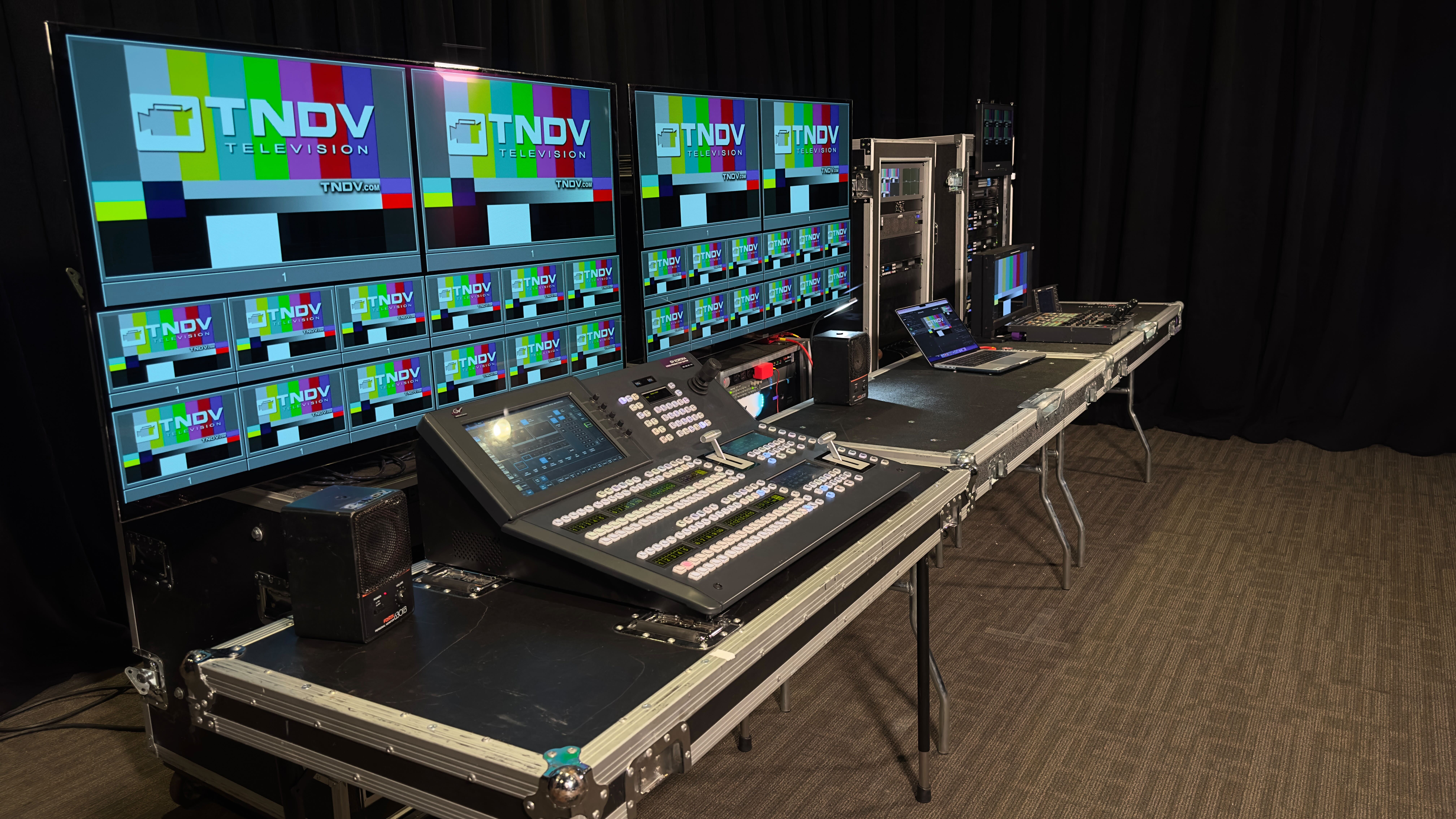 Fly Packs: Flexible Multi-Camera Streaming for Any Venue